Showing posts with label institutions. Show all posts

Friday, May 26, 2017

Boetkke on Buchanan

by Levi Russell

I've enjoyed reading every bit of George Mason University economist Peter Boettke's work that I've had the time to read in the past several years. His work is very interesting in part because he addresses issues most of us don't spend a lot of time on. In this post, I reproduce some of my favorite quotes from a recent speech Boettke gave. The speech focuses on Jim Buchanan's perspective on economics generally and political economy specifically. As usual, I suggest you read the whole speech, as it is very good and very short.

The problem as Buchanan sees it is that economics as a discipline has a public purpose, but modern economists have shirked on that purpose and yet are still being rewarded as if they were earnestly working to meet their educational obligation. As he put it:“I have often argued that there is only one ‘principle’ in economics that is worth stressing, and that the economist’s didactic function is one of conveying some understanding of this principle to the public at large. Apart from this principle, there would be no general basis for general public support for economics as a legitimate academic discipline, no place for ‘economics’ as an appropriate part of a ‘liberal’ educational curriculum. I refer, of course, to the principle of the spontaneous order of the market, which was the great intellectual discovery of the eighteenth century” (1977 [2000]: 96).

Prices serve this guiding role, profits lure them, losses discipline them, and all of that is made possible due to an institutional environment of property, contract and consent. These are the basic principles from which we work in economics. Important to note, economic analysis relies neither on any notion of hyper rational actors myopically concerned with maximizing monetary rewards, nor on postulating perfectly competitive markets. It relies simply on the notion that fallible yet capable human beings are striving to better their situation, and in so doing enter into exchange relations with others. Atomistic individualism and mechanistic notions of the market is, as Buchanan has stressed, nonsensical social science.

From a Buchanan perspective, basic economics can be conveyed in 8 points.
1.Economics is a "science" but not like the physical sciences. Economics is a "philosophical" science and the strictures against scientism offered by Frank Knight and F. A. Hayek should be heeded.
2. Economics is about choice and processes of adjustment, not states of rest.Equilibrium models are only useful when we recognize their limits.
3. Economics is about exchange, not about maximizing. Exchange activity and arbitrage should be the central focus of economic analysis.
4. Economics is about individual actors, not collective entities. Only individuals choose.
5. Economics is about a game played within rules.
6. Economics cannot be studied properly outside of politics. The choices among different rules of the game cannot be ignored.
7. The most important function of economics as a discipline is its didactic role in explaining the principle of spontaneous order.
8. Economic [sic] is elementary.

Wednesday, April 5, 2017

Big Ag Antitrust Blog Symposium

by Levi Russell

Recently I was part of a blog symposium put together by the International Center for Law and Economics at the Truth on the Market blog. The posts were quite diverse in terms of subject matter and perspective, so I think they're worth a read if you want to get a better understanding of what is going on with the Bayer/Monsanto, Dow/DuPont, and ChemChina/Syngenta mergers and acquisitions. There were some great contributions from the lawyers and economists on the panel and I was humbled to be invited to be a part of it. Below are links to the posts in order of the authors' last names.

Shubha Ghosh - Patents and mergers

Allen Gibby - Conglomerate effects and the incentive to deal reasonably with other providers of complementary products

Ioannis Lianos - Finding your way in the seeds/agro-chem mergers labyrinth

Geoffrey Manne - Innovation-driven market structure in the ag-biotech industry

Diana Moss - Mergers, innovation, and agricultural biotechnology: Putting the squeeze on growers and consumers?

Nicolas Petit - Antitrust review of ag-biotech mergers: Appropriability versus cannibalization

Levi Russell - Contestability theory in the real world
                        Effects of gene editing on ag-biotech antitrust

Joanna Shepherd - Understanding innovation markets in antitrust analysis

Michael Sykuta - Innovation trends in agriculture and their implications for M & A analysis

Friday, March 31, 2017

More Demsetz on Externalities

by Levi Russell

I recently ran across a lecture by Harold Demsetz presented at the Property and Environment Research Center in Montana back in 2011. Unfortunately, the video isn't online anymore, but I did find a written version. It's fairly short as lectures go, so I recommend you read it. If you don't have time to read 11 pages, check out the excerpts below.

Demsetz starts off by discussing the perfect competition model (which he calls the "perfect decentralization model"). This provides the backdrop for his discussion and critique of Pigou and Coase.
Consider Pigou’s method of argument first. He constructs examples of divergences between private and social cost. These examples differ circumstantially but in their nature s they are all the same. A favorite example involves the misallocation of traffic between two roads that connect the same terminal points. One road is subject to considerable congestion because it is narrow; the other road is wide and escapes much of this congestion but takes longer to transit because it lacks the directness of route of the narrow road. Pigou claims that the equilibrium number of autos using the narrow road will be inefficient. This is because drivers using this road do not take account of the costs of increased congestion they impose on others who use the road.  But what Pigou fails to do is show that the se example s are consistent with the presumptive conditions set down in the perfect decentralization model.  Frank H. Knight (1924), in a brilliant article on social cost, criticizes Pigou’s two -¬‐ road example. He notes that Pigou allow s free access to the two roads. Presumably, then, these roads are publicly provided and managed and, as such, cannot be a basis for criticism of private re source allocation. Knight argues that these roads, had they been private, would have been priced (in a competitive setting) so as to achieve an efficient allocation of traffic; price to use the narrow road would have been raised to levels higher than to use the broad road. Pigou’s examples do not uncover a logical flaw in the neoclassical model, since virtually all are based on an absence of private ownership. This is not to say that all resources in a real economy are privately owned but that Pigou’s work is properly interpreted in terms of the consequences of an absence of private ownership (or, more provocatively, as the presence of mismanaged public or collective ownership) than as inefficiency deduced within the context of the neoclassical model.
...
Coase noted a defect in Pigou’s argument that in its nature was much like that seen by Knight but which was not based on the absence of private ownership. Coase pointed to Pigou’s failure to recognize that the cost of using the price system disrupted the ability of a market-¬‐based price system to face users of resources with the full consequences of the uses they chose. Free use of the price system was implicitly assumed in the neoclassical model, since it treats prices as known to all who would use them. Coase’s complaint about neoclassical economics is empirical error, not logical error. The empirical error being that its model abstracts from an important aspect of the real world. As described above, Pigou gave no explanation for why a separation between private and social cost should exist in an economy that conforms to the conditions of perfect decentralization. Coase also offers no reason; instead, he openly modifies the perfect decentralization model to accommodate the fact that positive costs must be incurred to engage in exchange. The modified model allows him to rationalize the existence of a separation between private and social cost, or so he thinks. Just what this cost consists of remains somewhat vague, but I adopt Coase’s general notion.
 ...
Coase demonstrates the importance of transaction cost by way of two contrasting cases. The first shows that no difference between private and social cost can exist if the cost of transacting is zero, since, in this case, all who would bear costs from someone’s actions can bring these costs into that person’s calculations by making him or her offers to desist or modify the intended actions; similarly, this person can require revenues from those who would benefit from these actions. Nothing is left unaccounted for as long as legal rights of actions are in place. Coase’s argument is correct in this case. His presentation of the second case, involving positive transaction cost, claims that inefficiency may arise because some of the negotiations required to account for all costs and benefits cannot surmount the barrier put in place by transaction cost even if legal rights of action are in place. And here, Coase makes an error that still goes unappreciated by economists. 
 ...
Coase has treated the legal system and its courts as if they are parts of the economic system that was modeled by neoclassical economists, but, as already noted, their model assumes that all resources are privately owned and that ownership is fully respected; there is no place in it for the courtroom drama imagined by Coase. Moreover, real social systems in fact design courts so as to insulate them the influence of the marketplace. Offers and acceptances of payments to the court for desired decisions are illegal, and court survival is not made to depend on earned profit from decisions rendered. The neoclassical model of an economy and the conclusions drawn from it are confined to economic institutions, to firms, buyers, sellers and so on. The model draws no conclusions about resource allocation which results from actions taken by non-¬‐market institutions like courts and legislatures. In any case, Pigou did not base his examples of inefficiency on ownership ambiguity or court mistake.

While adopting the neoclassical perspective of market behavior, which sees ownership and markets as instruments by which resource values are maximized, Coase has relied on court decisions to assess the efficiency of the economic system. The implication he draws, that the economic system has made a mistake in allocating resources, is quite wrong. The court may have made its choice of owner for reasons different from maximization of market value or it simply may have made a mistake because it is not guided in its decisions by a market-¬‐based calculus. These reasons may seem good to some and bad to others, but they are irrelevant to the externality problem whose proper domicile is wholly within the economic system. Indeed, although there are good reasons for not creating a different legal system, if the court were to be transformed into a market institution and allowed to survive only by revenues secured from petitioners who buy its services and decisions, control of a resource would go to the person who can put it to its highest value use.

The economic system simply takes the court’s decision as an exogenously imposed constraint on its operations, much as it takes a decision by the State to tax or redistribute wealth. An efficient economic system is one that makes the most of scarce resources within the constraints handed down to it by courts and legislatures. Efficiency requires the market to block the transaction between the two claimants discussed above if the cost of their transacting exceeds the increase in value expected to be realized from a change in ownership of the resource.
 ...
There is no difference between transaction cost and other costs in this respect. The amount of soot from the production of steel may remain greater than is desired by the owner of a nearby laundry because the cost of transacting between laundry and mill owners is too great to make a transaction worth undertaking or because the launderer and steel mill owner believe that the cost of substituting hard coal for soft is greater than the cost borne by the launderer as a result of soot. In both cases, more soot descends on the laundry than if the cost of reducing soot were smaller. If we do not think resources are misallocated in the case in which hard coal is too costly to use, why should we think resources are misallocated in the case in which transaction cost is too costly to bear? Both situations are compatible with efficient resource allocation, and, after all, it is efficiency that is sought; neither negotiations nor hard coal are sought in and of themselves. Indeed, one can rewrite the neoclassical model with transaction cost included. This just shifts supply curves upward (or demand curves downward), but it carries no implications of inefficiency at equilibrium values of price and output.

I emphasize that none of what is written above denies the possibility of inefficiency in a competitive, private ownership economy. My message is that this possibility is not a result of positive transaction cost. Our reliance on a transaction cost rationale has caused us to exaggerate the scope of what externality problem might remain.
 ...

By now, the reader must suspect me of playing a word game. In part I am, but the game is not my doing. ‘Externality’ means nothing if it does not suggest something apart from a reckoning. Yet, a non-¬‐trivial component of what is written above makes a case that there is no ‘apartness’ from the market calculus. Something rationally not ‘worth’ taking into account is not equivalent to error or to inefficiency. That it is not taken into account is a reckoning if it follows from an anticipation that it is not worth taking into account. An explicit accounting for everything would be inefficient in a world in which knowledge is not free. 
 ...

Supply and demand as interpreted by the neoclassical model are expressions of true willingness to cooperate in a world that is highly dependent on specialization for its wealth. The neoclassical model faces buyers and sellers with given, non-­‐negotiable equilibrium market prices, determined on markets that cannot be influenced by individual bargaining. The model is not designed to treat strategic action, yet examples such as climate change and atmospheric quality represent problems that arise from the attempt to get others to settle for a smaller share of the surplus made available through cooperative behavior.


A close reading of Pigou and Coase does not reveal concern about strategic behavior. The distribution of traffic between Pigou’s two roads is inefficient because no price is charged for using them, not because drivers deceive each other. The failure to realize maximum value from available resources in Coase’s court room drama is a problem of legal error, not one of false testimony.


What advantage does the State bring to the resolution of strategic problems? It brings legitimate power to coerce; in these instances, the power to coerce people to pay for a public good. Just as we find that the State’s ability to coerce makes it a desirable agent in helping to maintain law and order, so we may find it a desirable agent in helping to finance production of goods and services that are important and are subject to serious strategic bargaining problems. It is possible in some instances to remedy the problem through a proper set of private rights –substitute a toll way for a free way. In other instances, the effective use of coercive power might require direct implementation by the State. People will value the alternatives of coercive State and voluntary-­‐dealings markets differently, depending on the confidence in which they hold the State and on the value they attach to personal freedom, but I see no reason to classify these important problems as externality-­‐caused inefficiencies. This now seems to me to be a classification without content.
 

Wednesday, February 8, 2017

Ostrom on Herbicide Resistance Management

by Levi Russell

I thought I'd share an interesting article I ran across last month on community-based approaches to herbicide resistance. The authors focus on the work of Elinor Ostrom as they evaluate the history of community-based solutions to common-pool resource problems and discuss how these solutions might be applied to herbicide resistance. Here's an excerpt from the conclusion:

What is to be done? First, we can recognize the wisdom of the Nobel Economic Sciences Prize Committee for awarding Elinor Ostrom part of the 2009 prize in economics for “for her analysis of economic governance, especially the commons.”—Oliver Williamson deservedly shared the prize for his “analysis of economic governance, especially the boundaries of the firm". There is now a rich body of research on managing common pool resources that can inform community-based approaches to resistance managements. Second, to organize to prevent herbicide resistant weeds, farmers and other stakeholders do not have to start from scratch. The multiple examples of community-based programs to control mobile insects and invasive weeds illustrate that farmer groups—in collaboration with and assistance from the research and extension communities—have organized effectively to overcome barriers to collective action problems. There is legal and administrative precedent as well as institutional memory that could aid farmers in developing resistance management programs based on programs they are already familiar with and which have a record of success. The particulars of herbicide resistant weed management will certainly differ from such insect and invasive weed programs. Insect biology and movement differs in spatial and temporal dimensions from that of weeds. And insect eradication programs have at times relied on mandatory area-wide spraying or practiced area-wide sterile insect releases. While both these actions took discretion out of the individual farmer’s hands, they were actions that farmers collectively accepted. Other organizational arrangements may also serve as useful examples. Endres and Schelsinger (2015) suggest that drainage districts perhaps provide a structure that can be replicated for effective community-based herbicide resistance programs.

Saturday, December 31, 2016

Testing Market Failure Theories

by Levi Russell

I recently picked up a copy of Tyler Cowen and Eric Crampton's 2002 edited volume Market Failure or Success: The New Debate (now only in print with the Independent Institute, though it was originally published by Edward Elgar) and have really enjoyed what I've read so far. The book is a collection of essays by prominent IO scholars organized into four sections: a fantastic introduction by the editors, four essays that form the foundation of the "new" market failure theories based on information problems, four theoretical critiques of said theories, and 8 essays providing empirical and experimental evidence of the editors' thesis: that information-based market failure theory is often merely a theoretical possibility not borne out in real life and that economic analysis of knowledge often provides us with the reasons why.

Two pieces by Stiglitz are featured in the first theoretical section: one on information asymmetries and wage and price rigidities and the other on the incompleteness of markets. Akerlof's famous "lemons" paper and Paul David's paper on path dependence are also included. I was happy to see that Demsetz's "Information and Efficiency; Another Viewpoint" was the first essay in the theoretical critique section as it sets the stage for the other chapters in that section. The empirical and experimental section features Liebowitz and Margolis' response to Paul David on path dependence in technology, Eric Bond's direct test of Akerlof's "lemons" model, and an essay I've never ready by Gordon Tullock entitled "Non-Prisoner's Dilemma."

The introduction provides a short summary of the arguments presented in the following 3 sections and includes a great discussion of the editors' views of the core problems with information-based market failures. Here's the conclusion of the intro chapter:
Our world is a highly imperfect one, and these imperfections include the workings of markets. Nonetheless, while being vigilant about what we will learn in the future, we conclude that the 'new theories' of market failure overstate their case and exaggerate the relative imperfections of the market economy. In some cases, the theoretical foundations of the market failure arguments are weak. In other cases, the evidence doe snot support what the abstract models suggest. Rarely is analysis done in a comparative institutional framework. 
The term 'market failure' is prejudicial - we cannot know whether markets fail before we actually examine them, yet most of market failure theory is just theory. Alexander Tabarrok (2002) suggests that 'market challenge theory' might be a better term. Market challenge theory alerts us to areas where market might fail and encourages us to seek out evidence. In testing these theories, we may find market failure or we may find that markets are more robust than we had previously believed. Indeed, the lasting contribution of the new market failure theorists may be in encouraging empirical research that broadens and deepens our understanding of markets.
We believe that the market failure or success debate will become more fruitful as it turns more to Hayekian themes and empirical and experimental methods. Above, we noted that extant models were long on 'information' - which can be encapsulated into unambiguous, articulable bits - and short on the broader category of 'knowledge,' as we find in Hayek [Hayek's 1945 article The Use of Knowledge in Society can be read here for free. A short explanation of the main theme of the article can be found here. - LR]. Yet most of the critical economic problems involve at least as much knowledge as information. Employers, for instance, have knowledge of how to overcome shirking problems, even when they do not have explicit information about how hard their employees are working. Many market failures are avoided to the extent we mobilize dispersed knowledge successfully. 
It is no accident that the new market failure theorists have focused on information to the exclusion of knowledge. Information is easier to model, whereas knowledge is not, and the economics profession has been oriented towards models. Explicitly modeling knowledge may remain impossible for the immediate future, which suggests a greater role for history, case studies, cognitive science, and the methods of experimental economics. 
We think in particular of the experimental revolution in economics as a way of understanding and addressing Hayek's insights on the markets and knowledge; Vernon Smith, arguably the father of modern experimental economics, frequently makes this connection explicit. Experimental economics forces the practitioner to deal with the kinds of knowledge an behavior patterns that individuals possess in the real world, rather than what the theorist writes into an abstract model. The experiment then tells us how the original 'endowments' might translate into real world outcomes. Since we are using real world agents, these endowments can include Hayekian knowledge and not just narrower categories of information. 
Experimental results also tend to suggest Hayekian conclusions. When institutions and 'rules of the game' are set up correctly, decentralized knowledge has enormous power. Prices and incentives are extremely potent. The collective result of a market process contains a wisdom that the theorist could not have replicated with pencil and paper alone.

Thursday, October 13, 2016

Some Alternative Views on the Recent Nobel

by Levi Russell

I enjoy talking about and linking to alternative, minority points of view in economics on this blog. Sometimes the views I talk about are genuinely only held by a minority, others are held by many but are under-emphasized or, in my mind slightly misunderstood.

In this case, I just want to link to some short (and one very long) posts I read about Hart and Holmstrom's Nobel. Certainly I'm happy to see the prize go to work on theory of the firm and contracts and I believe they are deserving of it. That said, here are some alternative perspectives you might not read in other outlets.

Pete Boettke has a rather long, but certainly interesting, post here.

Arnold Kling gives his thoughts in two posts here and here.

Finally, here's Peter Klein on the prize.

Friday, October 7, 2016

Farmers as Environmentalists

by Levi Russell

This morning in my daily ag reading I came across an article entitled "Greens Make Green." The author lays out the case for the farmer-as-environmentalist better than I've ever seen, so I thought I'd share it here. The underlying economic argument here is that there is great incentive compatibility between farmers (who are interested in long-term profits) and environmental sustainability. Do you find it compelling? Let me know in the comments.

In truth, farmers and environmentalists should be allies. The environmental and agricultural communities have more in common than conventional wisdom might suggest. Both desire to preserve our planet and its resources for future generations. I am not shy about saying farmers are the original environmentalists.

To a person, every farmer I have ever met is driven by an ethical obligation to protect the environment. They view themselves as stewards of the land. And for good reason: Nearly all want their children and grandchildren to carry on the tradition. Cousins Scott and Tom Deardorff II reflect the common theme of sustainability that connects the past to the present and future. Founded in 1937 by patriarch and great-grandfather W. H. Deardorff, Southern California-based Deardorff Family Farms has dedicated four generations to refining its environmental craft. For nearly eight decades, the Deardorff family has been driven by the relentless pursuit of improvement, pioneering many farming practices aimed at increasing productivity while reducing their reliance on natural resources.

Today, Scott and Tom have not only embraced but expanded the family legacy of stewardship. For example, they have invested heavily in the latest water-saving technologies, including drip irrigation and state-of-the-art weather stations and soil moisture monitors. The cousins have also curtailed the use of fertilizer and pesticides on their organic vegetable farms through innovative soil fertility programs and integrated pest management systems. And they recently completed construction on a cooling and packing facility that meets the highest green building standards in the country.

Multigenerational farms like theirs are the heart and soul of agriculture in the West and across the country. They are the very embodiment of sustainability. We should be so lucky as to entrust all our natural resources to the collective care of such thoughtful stewards.

If you can't bring yourself to buy the moral argument, at least consider renting the financial one. Farmers are business owners. They are motivated by sustainable profit. Their businesses are dependent on healthy soil and clean water, both of which lead to stronger yields and higher quality products. The math is quite simple: An environmentally healthy farm can deliver sustainable profits, while land that has been abused will one day cease to produce anything. Furthermore, inputs like fertilizer and pesticides are expensive; a business that doesn't minimize operating costs won't stay in business very long. Clean air, soil, and water are all outcomes supported by environmentalists. So why do so many continue to paint farmers as the enemy?

In his farewell address, President Eisenhower famously warned the nation against "unwarranted influence .  .  . by the military-industrial complex." Today we see the maturation of an environmental-industrial complex, defined by multimillion-dollar global enterprises closely integrated with academia and government regulators implementing environmental programs.

Like a storyline out of Mad Men, environmental activists have channeled their inner Don Drapers, fomenting fear of business and industry, and of human activity generally, in order to build a database of committed donors. It is an ingenious business model, used by corporate America since the early 1920s, when Gerard Lambert stigmatized halitosis to sell Listerine. Marketers have long understood that fear is a powerful motivating tool.

Every cause needs a bad guy, a threat that must be put down. For Listerine, it was bad breath. For too many environmental organizations, farmers—cast as the pillagers of Mother Earth—have served as compelling bogeymen (typically referred to as "corporate agriculture," "industrial agriculture," or the like) to alarm the 98 percent of Americans who aren't farmers.

We are all motivated to some degree by self-interest. Farmers are motivated by the love of farming and social good that comes from providing healthy food, and they are also motivated by the desire to succeed financially. Environmental activists working in big organizations aren't all that different. There is no doubt that most choose a career based on a commitment to environmental values and a desire to do good. And there is also no doubt that another motivation, and one that is entirely defensible, is the financial reward and career security that these organizations can provide.

Unfortunately, in the public debate, it is perfectly acceptable to point to farmers' financial motivations and equally unacceptable to acknowledge the financial motivations of environmental advocates. Those in private enterprise who are targeted by the policy and political initiatives of the environmental lobby ought to be more vocal about that.

If one can acknowledge the reality that the environmental lobby is motivated not only by the values of environmentalism, but also by the financial rewards of growing a motivated donor base, one might ask whether it would benefit these organizations to ever declare a problem solved. After all, while committed donors might feel good upon hearing such an announcement, they would also have one less reason to contribute.

Nowhere was this more in evidence than during the opposition waged against Senator Dianne Feinstein's compromise California drought legislation in 2014, which culminated in a joint-letter from multiple organizations slamming her bill.

Not one to seek the ire of environmentalists, the senator candidly responded—as quoted in the San Francisco Chronicle—that they "have never been helpful to me in producing good water policy." She went on to lament, "I have not had a single constructive view from environmentalists of how to provide water when there is no snowpack."

The practice of environmental protection and the business of environmentalism are two sides of a scale. Our nation's natural resources have benefited from much that has come from the former, but today the scale is weighted too much to the latter. It is the business side of environmentalism that produces the political targeting of agriculture.

It should stop. We share a common aim: to safeguard the planet for its people, animals, and plants. Imagine how much good could be accomplished if all farmers, regardless of size, whether conventional or organic, were accepted and embraced as partners for environmental protection. Now that is a narrative I know Don Draper could sell.

Tom Nassif is president and CEO of the Western Growers Association.


Monday, September 19, 2016

Anti-Trust vs Regulation: The Case of Baysanto

by Levi Russell

Bayer's impending purchase of Monsanto is all over the news lately. As is typical in these situations, the conversation centers around concerns of increasing market power and monopoly profits. Regular readers might expect me to focus on the notion that industry concentration doesn't necessarily imply welfare losses, but I'm not.

It seems to me that the relationship between anti-trust legislation and regulation is an under-discussed issue in these cases. Agribusiness firms are heavily regulated by three of the most powerful regulators in the US: the FDA, the USDA, and the EPA. Many regulations function as fixed costs, implying that there are economies of scale in regulatory compliance. Thus, the greater the regulatory burden placed on firms in an industry, the greater the inducement to merge.

These regulatory economies of scale militate directly against the goals of anti-trust policy. The latter, perhaps as an unintended consequence, gives us fewer and larger firms while the latter attempts to reign in these cost-saving mergers in the name of competition. If we're going to seriously discuss regulation and anti-trust, we need to be cognizant of the interplay between them.

Of course, there are plenty of problems with the regulatory revolving door and other public choice issues to deal with as well. On this front, it seems fairly obvious that the incentive to rent-seek is positively correlated with the prize being offered. Perhaps this is an argument for less power vested in the administrative state and more power returned to the courts.

Wednesday, September 7, 2016

Remembering Ronald Coase

by Levi Russell

The third year anniversary of Ronald Coase's death was last Friday. My Facebook and Twitter were alive with remembrances of this great economist, so I thought I'd put a few articles/videos/podcasts related to Coase for FH readers.

Though Coase is most famous for his work on transaction costs, what I find most interesting about his is his unique approach to economics in general. In the opening of this video interview, Coase says "Economics has become a theory-driven subject and I believe the approach should be empirical. You study the system as it is, understand why it works the way it does, and consider what changes could be made and what effects they would have." Coase derisively referred to abstract theoretical economics as "blackboard economics." In reading his work, the reader gets the sense that Coase is looking at the behavior of real people and trying to determine the underlying causal mechanisms. This is what makes Coase a great economist.

Here's an article on Coase that gives his background and surveys his most popular work. Here's a video featuring lectures on Coase's contributions by other well-known economists.

The video I linked to above, as well as this blog post of mine featuring Deirdre McCloskey, corrects the record on "the Coase Theorem." Speaking of my blog posts, here's another one that provides a summary of one of Coase's lesser-known, but no less fantastic, papers.

Finally, this post of mine summarizes a point by Bryan Caplan that, given his stated perspective on economic theory, I think Coase would have appreciated. It's a simple empirical observation that fundamentally challenges typical applications of standard monopoly theory.

Thursday, September 1, 2016

Rent-Seeking and Regulation are Inseparable

Over at Marginal Revolution, Alex Tabarrok links to a piece by Tim Carney on a move by the Securities and Exchange Commission to continue requiring mutual fund companies to send mostly-worthless documents to their clients. I've reproduced the Marginal Revolution post below (Carney indented, Tabarrok in italics):

Five years ago, a new quirky-sounding consumer-rights group set up shop in a sleepy corner of Capitol Hill. “Consumers for Paper Options is a group of individuals and organizations who believe paper-based communications are critically important for millions of Americans,” the group explained in a press release, “especially those who are not yet part of the online community.”

This week, Consumers for Paper Options scored a big win, according to the Wall Street Journal. Securities and Exchange Commission chairman Mary Jo White has abandoned her plan to loosen rules about the need to mail paper documents to investors in mutual funds.

Mutual funds were lobbying for more freedom when it came to mailing prospectuses — those exhaustive, bulky, trash-can-bound explanations of the contents of your fund. In short, the funds wanted to be free to make electronic delivery the default, while allowing investors to insist on paper delivery. This is an obvious common-sense reform which would save whole forests of trees.
You won’t be surprised to lean that Consumers for Paper Options is funded by paper mills, timber firms and the Envelope Manufacturers Association.

What bothers me about these stories is not the rent-seeking–that is to be expected. What bothers me is that there is a law that prescribes how mutual funds must inform their customers. Why must every aspect of commercial life be governed by a gun? And this is where I expect pushback–the mutual funds will rip us off if we don’t have these laws, blah, blah, blah. Fine, believe that if you must, but then you have no cause to complain about rent seeking. You created the conditions for its existence.

Friday, August 12, 2016

The Legacies of Jim Buchanan and Elinor Ostrom

by Levi Russell

About a month ago I ran across a blog post entitled "How to start thinking like a public choice economist." Given my interest in this field of study, I read and enjoyed the post and watched the (short) video interviews. Another post entitled "Putting the action back in collective action" recently came out on the same site, so I thought I'd share them both.


If you're interested in the work of Jim Buchanan and Elinor Ostrom (Nobel Prizes in Economics in 1986 and 2009, respectively), I'd encourage you to check out the posts and videos.

Tuesday, August 9, 2016

100 Years of Zoning

by Levi Russell

In the past I've discussed zoning laws, referencing articles that compare present vs past policies and that explain the unusual case of Houston, TX. More recently I read an article on Bloomberg with a provocative title: "Zoning has had a Good 100 Years, and That's Plenty." The author's main point is that the costs of zoning laws (primarily their negative effects on the poor) outweigh the benefits. Below are some passages I particularly liked.

Over the past few years, zoning has been blamed, mainly by economists bearing substantial empirical evidence, for an ever-growing litany of ills. The charge that zoning is used to keep poor people and minorities out of wealthy suburbs has been around for decades. But recent research has also blamed it for increasing income segregation, reducing economic mobility and depressing economic growth nationwide.

One can never be certain about these things, but it’s quite possible that excessive land-use restrictions are among the major causes of our long national economic malaise.  Jason Furman, chairman of the White House’s Council of Economic Advisers, made this very point in a speech in November. Yet the platform adopted at the Democratic National Convention this week made no mention of either “land use” or “zoning,” while the Republican platform mentioned them only to condemn the current administration’s purported efforts “to undermine zoning laws in order to socially engineer every community in the country.”
 ...

Dartmouth College economist William Fischel, whose excellent book “Zoning Rules!” has been my most important source on this topic, favors a different explanation. In the decades before the automobile, industrial and residential development was to a large extent constrained by the location of rail and streetcar lines. After trucks and buses became common, though, industrial businesses could locate far from railways (and wharves) and apartment developers could build far from streetcar lines. Anxious homeowners -- and in some cases, merchants -- clamored for rules to keep people from building factories next door.

This does seem to have been one of the motivating factors in New York. According to David W. Dunlap’s New York Times column Monday on the zoning anniversary, “the merchants of Fifth Avenue were losing their retail customers and watching the value of their properties drain away, as big loft buildings for garment manufacturers muscled in around them.” Still, as America’s least auto-centric city, New York also focused its zoning rules on concerns -- skyscraper design, for example -- that were less of an issue elsewhere in the country. It was to be another zoning ordinance adopted six years later in Euclid, Ohio, that ended up fully establishing zoning as a national institution. 
 ...

Sutherland [a Supreme Court Justice in the 1920s and 1930s - LR] affirmed that cities had every right to zone land without compensating landowners or businesses that were harmed. He also said -- unprompted by the facts of the case -- some strangely nasty things about apartment buildings. A sample:
Very often the apartment house is a mere parasite, constructed in order to take advantage of the open spaces and attractive surroundings created by the residential character of the district.
I find it really hard to read that as anything but an affluent guy justifying the legal exclusion of less-affluent people from his neighborhood. There’s been an element of class discrimination to zoning from the early days -- sometimes mixed in with racial discrimination. Still, there have always been other, more-positive aspects, too. In Fischel’s words, “zoning probably makes for more efficient provision of local services and better neighborhoods than would be available without it.”

After about 1970, though, zoning’s negative economic effects began to grow. Before then, housing prices were more or less the same across the country. Since then, prices in the metropolitan areas of the Northeast and West Coast have risen much faster than in most of the rest of the nation -- in the process increasing inequality, thwarting residential mobility and slowing economic growth. Ever-tougher zoning rules and restrictions on growth appear to be a major cause. Fischel has a long list of explanations for this intensification of zoning that I won’t go into here, other than to mention the one that drives me the craziest -- the dressing-up of self-interested economic arguments in the language of environmentalism and morality.

Thursday, July 14, 2016

Regulating the Regulatory Process

by Levi Russell

I suppose this is Mercatus Center week, but I can't resist sharing some great analysis and commentary from their researchers.

Senior Research Fellow Patrick McLaughlin recently testified before Congress on the need for an established process of regulatory form at the federal level. Drawing on the experience of the UK and Canada, McLaughlin presents several methods of establishing "regulatory budgeting." He describes this method of regulatory error correction this way:
Regulatory budgets, like other types of budgets, only work if they force the spender to identify and prioritize the most valuable options. The behavior of an agency with a budget differs from that of an agency without a budget. In today’s no-budget world, an agency’s objective is to fulfill its mission with the promulgation of rules. The effectiveness and efficiency of those rules are not evaluated in hindsight, and prospective evaluation of effectiveness and efficiency only occurs for less than one percent of all new rules. In contrast, an agency with a regulatory budget would act differently. First, the agency would avoid new regulations that would not achieve high benefits relative to their budgetary cost. Second, the agency would have incentive to eliminate old regulations that are found to be ineffective or intolerably inefficient. In other words, a regulatory budget process would resemble an error-correction process: it would lead to fewer new errors as well as aid in the identification and correction of existing ones.
 McLaughlin goes on to explain methods of setting the regulatory budget limit and several measures of regulation that could be used in this approach. I highly recommend reading the whole testimony.

Here's the conclusion:
Regulators and legislators alike are not perfect. Regulations are perhaps unique in the sense that they are undeniably important to all actions in the economy, but are not subject to a process for error correction. These errors—most of which are probably undiagnosed owing to the lack of retrospective analysis—are far from benign. They contribute to regulatory accumulation, a force that disproportionately harms low-income households, deters innovation, and slows economic growth, without delivering offsetting benefits. The reduction of the error rate requires a process that ensures the development and application of high-quality information, both before and after the effects of regulations have been observed. Regulatory budgeting represents one option to achieve just that.

Regulatory budgeting would lead to the creation of better information about the effects of regulations. Simultaneously, it would create incentives for regulators to act upon that information, promulgating those regulations that offer the greatest benefit relative to costs and eliminating regulations that impose an undue burden on the American people.

Thursday, July 7, 2016

Yes, Virginia, Plowing is Pollution

by Levi Russell

Obviously the title is meant to be facetious. I'm just in shock about this ruling and am concerned about the ramifications it will have for producers in the future.

Below I reproduce a short Farm Futures article that summarizes a recent court decision in California regarding the Clean Water Act. As cynical as I am, this decision did surprise me.

---

Judge Kimberly Mueller on June 10, 2016 in the U.S. Eastern District Court of California found that John Duarte, a nursery operator and wheat farmer, plowed wetlands, four to six inches deep, and therefore violated the Clean Water Act (CWA).

The Judge found Mr. Duarte, by chiseling a pasture, discharged fill material into a water (vernal pool) of the United States. Get this! The Court wrote “In sum, soil is a pollutant. And here, plaintiffs instructed [a contractor] to till and loosen soil on the property.”

This plowing, according to the Court, caused “…the material in this case soil, to move horizontally, creating furrows and ridges.” You will not believe this. 

The Court wrote, “This movement of the soil resulted in its being redeposited into waters of the United States at least in areas of the wetlands as delineated...” In sum, the Judge found that chiseling no more than a few inches of soil constituted an addition of a pollutant to a wetland.

Stunning!

The Court also evaluated whether the tractor and soil chisel plow were point sources under the CWA. The Court cited cases which found that bulldozers, backhoes, graders, tractors pulling discs and rippers can be point sources under the CWA.

The Court describes Mr. Duarte’s equipment as having 7 shanks with 24-inch spacing and each shank was 36 inches long. The Court wrote, “The equipment loosened and moved the soil horizontally, pulling the dirt out of the wetlands [vernal pools] and redepositing it there as well.” 

Vernal pools are described as meeting all three wetland parameters. They are dry the majority of time. As a result, the Court found that the equipment used to aerate the soil was a point source under the CWA.

Under the CWA there must be a discharge of a pollutant to navigable waters from a point source. Again, it is believed that to have a discharge of a pollutant, there must be an addition of the pollutant to the navigable waters. It is also believed that farming operations allegedly have an exemption under the CWA which exempts certain activities of farming and ranching from CWA permitting requirements. (The Court seems unaware that farming is considered a nonpoint source covered by section 319 of the CWA)

The CWA regulations defines farming and declares “Normal farming…activities such as plowing, seeding, cultivating, minor drainage and harvesting for the production of food, fiber and forest products,…” are not activities which are prohibited or regulated under the CWA. Plowing is also defined by EPA as meaning “…all forms of primary tillage, including moldboard, chisel or wide-blade plowing, discing, harrowing and similar physical means utilized on farm, forest or ranchland for the breaking up, cutting, turning over, or stirring of soil to prepare it for the planting of crops.”

The Court found that Mr. Duarte’s activities did not meet the exemption EPA has provided for farming. The Court believed that the land being aerated by Mr. Duarte had not been land used for farming activities but for the grazing of animals. (Grazing or pasturing of animals apparently is not an agricultural activity!) The Court believed the farming operation which could be exempted had ceased to operate as a farm, and that Mr. Duarte was engaging in new agricultural activities. 

Legal complications

The case is extremely complicated from a legal standpoint where Mr. Duarte sued the Army Corps of Engineers (Corps) claiming the Corps had violated his 5th Amendment right to due process and his 1st Amendment right against retaliatory prosecution. According to the opinion, there were two rounds of motions to dismiss significant evidentiary objections and objections over what constituted hearsay. The U.S. Department of Justice filed a counterclaim against Mr. Duarte using the CWA and won.

Basically the case says plowing can be a polluting activity particularly in areas that can be identified as vernal pools, vernal swales, seasonal wetlands, seasonal swales and areas where there may be intermittent and ephemeral drainages.

Mr. Duarte had purchased the land in order to plant winter wheat. He had been very careful in hiring consultants to identify any wetlands. Apparently what he did was insufficient according to Judge Mueller, an Obama appointee, who served as a City Councilwoman in Sacramento. In addition she has worked as a U.S. Magistrate Judge but appears to have no experience in agriculture. It shows!  It is indeed surprising that an attempt to grow wheat on approximately 450 acres results in the violation of the CWA.

Thursday, June 30, 2016

One Positive Result of Brexit

by Levi Russell

In the wake of the UK's referendum on its membership in the EU, there have been many positive and negative reactions. My own view is that, even with the potentially negative impact of tighter immigration restrictions, the UK will be better off without EU regulations and will likely have trade terms similar to those it had before (see Switzerland). In fact, the biggest proponents of the Leave campaign want free trade with the EU. Of course I could very well be wrong. It might have been better from a utilitarian/consequentalist point of view for the UK to remain in the EU.

I think there's one benefit of the UK's (potential) exit that is unambiguous: The UK citizenry will be better equipped to govern themselves. Specifically, the cost of monitoring their lawmakers has fallen dramatically. If and when the UK leaves the EU, Britons will only have to monitor the behavior of the 650 members of parliament (MPs). Outside of trade deals, the EU MEPs in Brussels will have no direct effect on them.

Additionally, the benefit of participating in the political process is higher as well. Each MP now controls a larger share of the laws and regulations under which Britons live. Thus, any influence Britons (whether individually or in groups) wield over MPs now carries more weight.

It's possible that, on net, the UK's (potential) exit from the EU will be very bad for the average British citizen. However, there are clear benefits from a public choice point of view.

Friday, June 24, 2016

Brexit Stock Market Perspective

by Levi Russell

The financial press was abuzz before and after the recent UK referendum to leave the European Union (see here, here, here, here, here, and here). To be sure, the British Pound took a big hit and several stock market indices across the Western world were affected. I'd just chalk this up to political uncertainty, not a referendum on the referendum. After all, we don't actually know if the UK will leave the EU. Perhaps I'm biased.

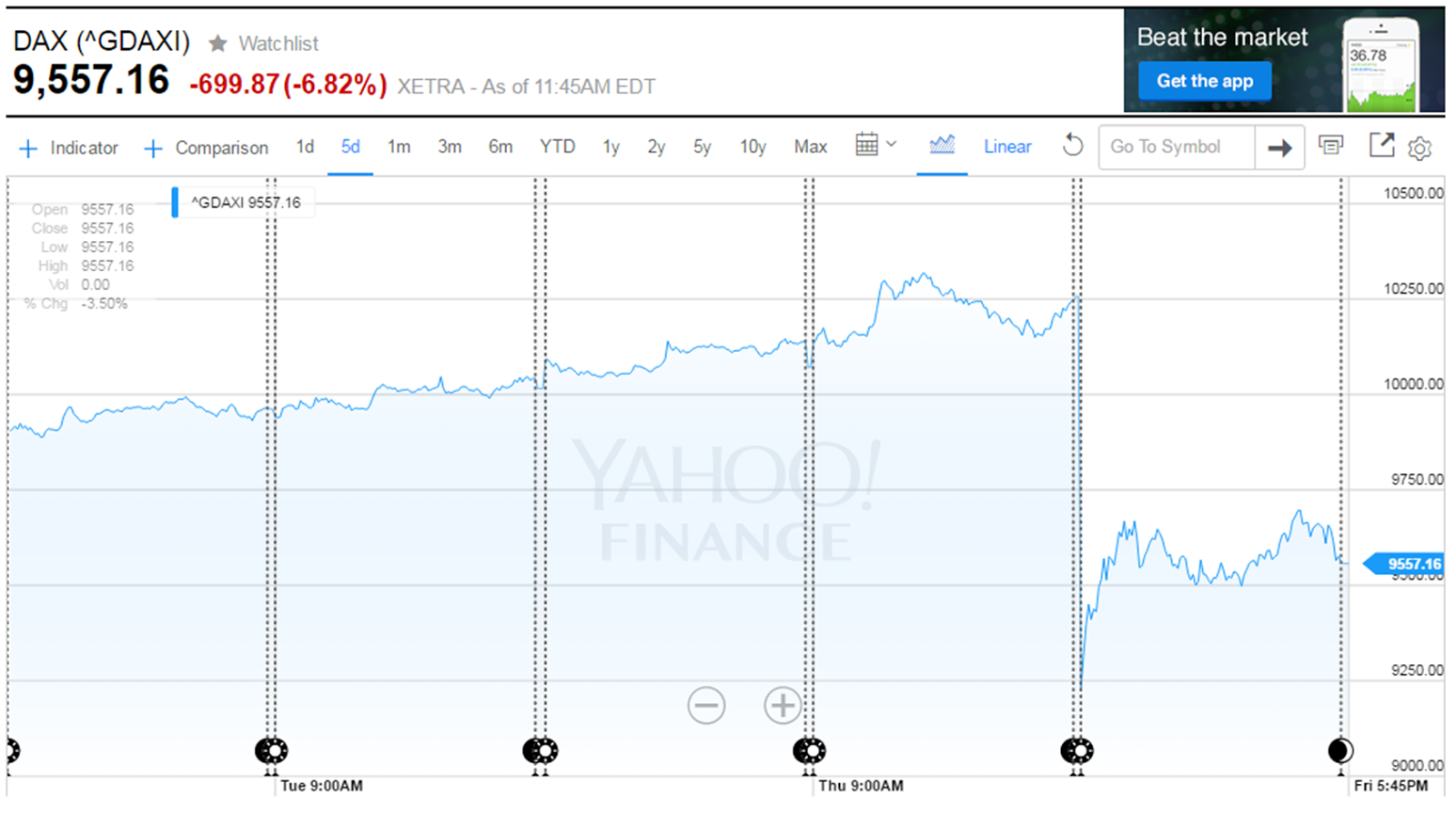
Here's the perspective I promised in the title. First, a look at the 5-day charts (all taken from Yahoo Finance) of U.S. (Dow and S&P 500), British (FTSE), Spanish (IBEX), German (DAX), and French (CAC 40) stock exchange indices:


To be sure, these are some pretty serious one-day drops. However, the Dow and S&P 500 fell more modestly than the others and the FTSE (British index) has recovered somewhat. The hardest hit so far are the European indices. Interesting, to be sure.

But what does this selloff look like over a 1 year time horizon? How far back in time do we have to go to see these indices at similar levels?


The Dow and S&P 500 are right about where they were last month. If you take out the big troughs in September 2015 and early this year, both indices are pretty much flat. The FTSE looks similar, though it seems to have a bit more of a downward trend than the U.S. The Spanish, German, and French indices are down a bit more relative to the past few months but it seems they're just continuing a downward trend that's been around for the past 12 months.

I'm not saying the referendum had no effect on the markets but after looking at these charts I'm left asking "Where's the fire?" Maybe I'm missing something, or maybe my cavalier attitude to the stock market stems from the fact that I'm 29 years old.