Showing posts with label farm bill. Show all posts

Tuesday, May 3, 2016

More 2014 Farm Bill Correlations

I thought I'd share some more correlations I've calculated as I work on my paper on the 2014 farm bill. The paper is about the way electoral incentives and legislator characteristics impacted votes on the bill. Check out my previous post for more. Keep in mind that these are simple correlations that don't necessarily tell us about causality between two variables.

Here is a cross-tabulation of the "yea" vote on the 2014 farm bill and the four Census bureau regions: Northeast (0), South (1), Midwest (2), and West (3).

Fewer than half the legislators in the Northeast voted in favor of the bill. This might have something to do with the cuts to SNAP and increase in crop insurance spending (which offset cuts in direct payments), but I can't be sure. Over 75% of Midwestern legislators voted in favor of the final bill. A majority of Southern and Western legislators voted for the bill but their margins were thinner at 67.5% and  59%. 

The correlation between "yea" votes, the percentage of households in a district or state that received SNAP funds in 2011-2013, the farm share of gross state product in 2013, and the percentage of the households in a district or state designated "rural" can give us a basic idea of how these legislative incentives affected the passage of the bill.

There's a weak positive correlation between SNAP household percentage and "yea" votes (0.0036), but it's not statistically significant. Legislators representing states or districts with larger farm economies or rural household percentages were more likely to vote in favor of the bill with correlations of 0.1627 and 0.3267, respectively.

Finally, looking at the correlation between ideology and PAC spending tells an intuitive story: more agricultural PAC money goes to more right-leaning candidates while more environmental PAC money goes to more left-leaning candidates. The correlations of interest are 0.2167 for agricultural PACs and -0.3314 for environmental PACs. Both are statistically significant at the 1% level.

To clarify, the ideology variable ranges from 0 to 1 with extreme left-wing being closer to 0 and extreme right-wing being closer to 1. This doesn't by itself imply that PAC spending by either group buys votes, but it is interesting to see just how strong (or weak, depending on your expectations) these correlations are. 

The correlation between environmental PAC spending and ideology is higher because environmental PAC spending seems to be more targeted. While agricultural PACs give quite a bit of money to almost all legislators, environmental PAC spending is lower with relatively high percentages of their total spending going to specific legislators. I'll get into this more later when I have a full summary of the paper. For now I plan to keep sharing interesting information as I go.

Sunday, April 24, 2016

Legislator Ideology and the 2014 Farm Bill

I'm currently working on a paper that examines the impacts of PAC spending and other influences on the passage of the 2014 Farm Bill. One variable that is nearly always important in other studies of  legislator votes is the legislators' ideology. I found some interesting data on ideology from GovTrack that I plan to use in the paper and thought I'd share some results of a fairly simple preliminary regression. GovTrack also has a leadership index for legislators which I'll leave for a later post.

Here are the ideology and leadership indices for the House and Senate for 2011-2016:


As you can see, the ideology score seems to do a good job of separating the two major parties. Looking at the 2014 scores specifically, it's even clearer. For example Senators Jim Inhofe, John Cornyn, and Pat Roberts all score near 1 on the ideology index (far right on the chart above); Senators Elizabeth Warren, Barbara Boxer, and Bernie Sanders score near 0 (far left on the chart); and Senators Joe Manchin, Lisa Murkowski, and Mark Pryor all score near the middle.

I took the data for the 2013-2014 legislative period and split it into 5 groups: far-left wing, left wing, center, right wing, and far-right wing which allows for non-linearity in the effect of ideology on the probability a legislator voted for the 2014 Farm Bill. I plan to use a few different versions of this breakdown in the paper.

In the model I controlled for the legislators' party, sex, whether they were Senators or Representatives, and whether or not they served on the Ag Committees in their respective houses.

As you can see below, 68% of Senators and about 60% of Representatives voted in favor of the bill (i.e. voted "yea") and only 8 of the 65 members of both Ag Committees voted against it.


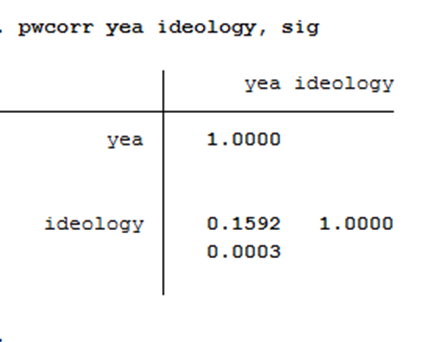
Looking at the correlation between a "yea" vote and the raw ideology index from GovTrack shows a weak but statistically significant positive correlation. The interpretation of this is that more right wing legislators were more likely to vote in favor of the bill.

Breaking down the ideology index into the 5 groups explained above and cross-tabulating with "yea" votes supports this to some extent. The charts below are: far-left wing ideology (top left on the chart), left wing ideology (top right), centrist ideology (middle), right wing ideology (bottom left), and far-right wing ideology (bottom right).

(click the image to enlarge)
The only ideological group with fewer than half "yea" votes for the final 2014 Farm Bill was the far-left ideology group. This is especially interesting considering that 75%-80% of the budget or spending from the Farm Bill has been committed to SNAP or "food stamps" in the past. However, there was an $8 billion cut in SNAP spending, which likely explains the far-left's dislike of the bill.*

So estimating a probit model with controls for party, house, sex, and Ag Committee membership gives us the following marginal effects:


Senators and members of the Ag Committee were, as expected, more likely to vote in favor of the 2014 Farm Bill. Compared to far-right wing legislators (the reference group), far-left wing legislators were 29% less likely to vote "yea" on the bill and right-wing legislators were 19.6% more likely to vote for the bill. There was no statistically significant difference in the probability of voting "yea" for left wing and centrist legislators relative to far-right wing legislators.

Looking again at the cross-tabs above, I think the regression analysis shows that there was, at least in the case of the most recent Farm Bill, a coalition of primarily right-wing and centrist legislators banding together with some far-right wing and left-wing legislators to pass the bill. While I have other variables to add to the model, I suspect that these relationships will hold up pretty well given the importance of ideology in other studies of legislative voting behavior. As always, I'm interested in readers' thoughts, suggestions, and questions.

*11:45 PM 4-24-2016 - I had previously stated that SNAP spending increased. Thanks to Keith Coble for the correction.

Friday, November 13, 2015

Crop Insurance Spending Myopia

In the last couple of weeks there's been a lot of focus inside the beltway on crop insurance. First, a 2-year budget deal between Republicans and Democrats planned to cut $3 billion from the crop insurance program. The deal would boost total spending by $80 billion (not including off-budget items) over 2 years. The $3 billion has since been restored to crop insurance in this bill.

More recently another bill called the "Assisting Family Farmers through Insurance Reform (AFFIRM) Act," has been proposed in both the Senate and House. The bill would cut $24.4 billion over 10 years from the crop insurance program by 1) capping RMA's premium share at $40,000, 2) eliminating RMA's share of the premium for all farmers with adjusted gross income over $250,000, 3) retaining the $3 billion cut to insurance providers, 4) reducing the commission paid to insurance salespeople, and 5) eliminating the Harvest Price Option.

The AFFIRM Act is, of course, being sold as a fiscally-conservative measure, but numbers can be deceiving. "Billion" is a big word, but context is important. 

I want to be clear here that I'm not advocating any cuts to or expansions of federal spending, I just want to bring some data to bear on the conversation.

Tuesday, August 11, 2015

Does the US Have a "Cheap Food" Policy?

It's often said, in defense of payments to ag producers, that these subsidies constitute a "cheap food" policy. Advocates of the policy contend that the subsidies incentivize increased production such that food prices fall. It's a win-win: producers benefit directly from the subsidy and consumers (especially the poor) benefit from reduced prices at the grocery store.

Leaving aside the question of whether or not these types of policies should exist, it's interesting to see whether the subsidies actually result in lower food prices. It's important to note that direct payments to producers have been reduced as of the 2014 Farm Bill and that the USDA spends an increasingly greater percentage of its budget on direct food assistance. That said, the article's findings are still interesting today.

With all that out of the way, I want to summarize the findings of a paper by Corey Miller and Keith Coble of Mississippi State University. The paper is relatively old; it was published in 2007 in Food Policy, but it nevertheless provides some interesting insights. The gated, full version is here and an un-gated but incomplete version can be found here.

Tuesday, June 16, 2015

Matt Bogard on GMOs and Farm Subsidies

Back in April, Matt Bogard posted a series of questions on GMOs and farm subsidies. As Matt notes, the typical view of ag subsidies is almost completely at odds with the data and relevant research.

I definitely recommend reading the whole thing, so here are his questions:

1) Do farm subsidies encourage farmers to plant biotech or GMO seeds?

2) If subsidies drive the production of commodities and most of these are GMO,  aren’t we indirectly subsidizing GMOs?

3) Do farm subsidies make unhealthy foods cheaper and contribute to obesity?

4) Do farm subsidies largely prop up wealthy farmers vs. helping small farmers thrive in a volatile, competitive global and corporate dominated marketplace?

I'm fairly confident that a large percentage of the population would confidently answer "yes" to each of these questions. The reality is either "no" or at least a much less emphatic "maybe."

Monday, May 18, 2015

Potpourri

I haven't done one of these in awhile, so I thought it was time to share a handful of links to some great stuff I've read recently.

Richard Ebeling at The Citadel offers a fantastic take down of the Keynesian view of recessions for the layman. It's certainly worth a read for the non-specialist in macro.

The always-insightful Don Boudreaux recently discussed the role of theory in measuring the effects of the minimum wage. He also provided a short note on the role of institutions in economic analysis in response to a reader's question and an interesting take on the economic way of thinking. Very good stuff.

Jayson Lusk recently weighed in on the fight between scientific integrity and consumer sovereignty in the food world. He also provided a short discussion of an article on crop insurance subsidies and risk taking.

John Tamny reviews a recent book on the myriad ways gov't policy has and will negatively affect the millennial generation.

Saturday, April 25, 2015

Potpourri

David Widmar has an interesting post detailing the usage of irrigation water across the country. The bottom line? The use of irrigation has increased in the Corn Belt and Southeast but has declined in the Southwest and West.

Matt Bogard asks (and answers) some big questions on the effects of ag policies. Matt argues that the distortions of policy in terms of the production of GMOs are relatively minor.

Jayson Lusk presents some summary information from the Food Demand Survey (FooDS). Increases in beef demand over the last two years are particularly apparent.

Shawn Regan dissects the claim that National Park attendance is at an all time high.

Matt O'Brien has an article summarizing new research on unemployment. A better measure of unemployment indicates that the U.S. economy is short 3.5 million jobs, not the 1 million jobs that headline unemployment would indicate. This implies that the economy is weaker than some might believe and that Federal Reserve policy is likely to remain accommodative longer than many expect.

Tuesday, February 24, 2015

Does Farm Policy Respond to Farm Performance?

Previously I discussed some findings from my recent working paper on ag regulation since 1997. In addition to regulation, we also looked at the effects of farm stabilization spending on profitability and productivity growth. Farm stabilization spending is a "function" category in the White House's Office of Management and Budget historical tables and refers to crop insurance indemnities, direct payments, and other program payments.

The results indicate that there's a statistically significant, negative relationship  between farm stabilization spending and both measures of farm performance. Specifically, profitability declined by -0.027% and productivity growth declined by -0.138% for every 1% increase in farm stabilization spending. Though these effects are statistically significant, they're small. However, the signs of the effects are more interesting than the magnitudes.

Friday, February 20, 2015

Political Power and the Farm Bill

I first ran across a working version of a recent paper by Marc Bellemare of the University of Minnesota and Nick Carnes of Duke University entitled "Why Do Members of Congress Support Agricultural Protection" a few months ago while doing some research for my paper on regulation in ag. The article does a good job of explaining how a relatively small constituency obtains such tremendous benefit through the national-level political process. The article is certainly worth a read, so I thought I'd give just a short summary (mostly from the abstract) and give some brief thoughts on it.

The authors examine three possible explanations for congressional support for US ag: lobbying, legislator preferences, and electoral incentives. They use data on votes by legislators for the 2002 and 2008 farm bills to examine the degree to which these possible sources of support for ag explain ag protection legislation in the US.