Showing posts with label behavioral econ. Show all posts

Monday, May 1, 2017

Review of Sunstein's Latest Book

by Levi Russell

I came across a review of Cass Sunstein's latest book The Ethics of Influence: Government in the Age of Behavioral Science by Michael D. Thomas in Public Choice. It's a great review that provides a succinct summary of each chapter. Since I'm often critical of Sunstein's "nudge" theory, I thought I'd share the last few paragraphs of the review. The review itself is, unfortunately, behind a paywall.

The Ethics of Influence appeals to the reader interested in the scope of government. It challenges Buchanan’s (2004) response to Warren Samuels about the “status of the status quo”. One could respond to Sunstein’s analysis by adding Buchanan’s observation that pure rent seeking results when the status quo is simply one among many possible outcomes. Another view would be that the status quo emerges tacitly over time. Here a defense of customary and common law could include writings by Hasnas (1995) on the emergence of law.

In dealing with Sunstein’s treatment of Hayek, it is important to respond not only to the explicit claims about how emergent law works, but also to his characterization of Mill’s harm principle. This is where public choice must defend the epistemic argument in Mill. The individual is not justified because he is a rational chooser, as Sunstein puts it. Instead, Mill says, “Men are not more zealous for truth than they often are for error…” (2009, p. 31). Multiple choosing groups do not preserve the truth, but the possibility for recovering lost truths. Readers might incorporate theories of discovery here, such as those developed by Kirzner (1985). Sunstein’s choice architects, on the other hand, form law through the inclusion of popular sentiment which reduces competing truth claims to one.

Since this book was published before the most recent presidential election, one wonders if such a view is weakened by the dramatic shift in popular sentiment and large changes in policy. Public choice concerns over who wields the power of this ever increasing authority gain additional profile from these recent events. The Ethics of Influence is a must read because it lays out many issues that are important for the next round of debates in public choice.

Saturday, December 31, 2016

Testing Market Failure Theories

by Levi Russell

I recently picked up a copy of Tyler Cowen and Eric Crampton's 2002 edited volume Market Failure or Success: The New Debate (now only in print with the Independent Institute, though it was originally published by Edward Elgar) and have really enjoyed what I've read so far. The book is a collection of essays by prominent IO scholars organized into four sections: a fantastic introduction by the editors, four essays that form the foundation of the "new" market failure theories based on information problems, four theoretical critiques of said theories, and 8 essays providing empirical and experimental evidence of the editors' thesis: that information-based market failure theory is often merely a theoretical possibility not borne out in real life and that economic analysis of knowledge often provides us with the reasons why.

Two pieces by Stiglitz are featured in the first theoretical section: one on information asymmetries and wage and price rigidities and the other on the incompleteness of markets. Akerlof's famous "lemons" paper and Paul David's paper on path dependence are also included. I was happy to see that Demsetz's "Information and Efficiency; Another Viewpoint" was the first essay in the theoretical critique section as it sets the stage for the other chapters in that section. The empirical and experimental section features Liebowitz and Margolis' response to Paul David on path dependence in technology, Eric Bond's direct test of Akerlof's "lemons" model, and an essay I've never ready by Gordon Tullock entitled "Non-Prisoner's Dilemma."

The introduction provides a short summary of the arguments presented in the following 3 sections and includes a great discussion of the editors' views of the core problems with information-based market failures. Here's the conclusion of the intro chapter:
Our world is a highly imperfect one, and these imperfections include the workings of markets. Nonetheless, while being vigilant about what we will learn in the future, we conclude that the 'new theories' of market failure overstate their case and exaggerate the relative imperfections of the market economy. In some cases, the theoretical foundations of the market failure arguments are weak. In other cases, the evidence doe snot support what the abstract models suggest. Rarely is analysis done in a comparative institutional framework. 
The term 'market failure' is prejudicial - we cannot know whether markets fail before we actually examine them, yet most of market failure theory is just theory. Alexander Tabarrok (2002) suggests that 'market challenge theory' might be a better term. Market challenge theory alerts us to areas where market might fail and encourages us to seek out evidence. In testing these theories, we may find market failure or we may find that markets are more robust than we had previously believed. Indeed, the lasting contribution of the new market failure theorists may be in encouraging empirical research that broadens and deepens our understanding of markets.
We believe that the market failure or success debate will become more fruitful as it turns more to Hayekian themes and empirical and experimental methods. Above, we noted that extant models were long on 'information' - which can be encapsulated into unambiguous, articulable bits - and short on the broader category of 'knowledge,' as we find in Hayek [Hayek's 1945 article The Use of Knowledge in Society can be read here for free. A short explanation of the main theme of the article can be found here. - LR]. Yet most of the critical economic problems involve at least as much knowledge as information. Employers, for instance, have knowledge of how to overcome shirking problems, even when they do not have explicit information about how hard their employees are working. Many market failures are avoided to the extent we mobilize dispersed knowledge successfully. 
It is no accident that the new market failure theorists have focused on information to the exclusion of knowledge. Information is easier to model, whereas knowledge is not, and the economics profession has been oriented towards models. Explicitly modeling knowledge may remain impossible for the immediate future, which suggests a greater role for history, case studies, cognitive science, and the methods of experimental economics. 
We think in particular of the experimental revolution in economics as a way of understanding and addressing Hayek's insights on the markets and knowledge; Vernon Smith, arguably the father of modern experimental economics, frequently makes this connection explicit. Experimental economics forces the practitioner to deal with the kinds of knowledge an behavior patterns that individuals possess in the real world, rather than what the theorist writes into an abstract model. The experiment then tells us how the original 'endowments' might translate into real world outcomes. Since we are using real world agents, these endowments can include Hayekian knowledge and not just narrower categories of information. 
Experimental results also tend to suggest Hayekian conclusions. When institutions and 'rules of the game' are set up correctly, decentralized knowledge has enormous power. Prices and incentives are extremely potent. The collective result of a market process contains a wisdom that the theorist could not have replicated with pencil and paper alone.

Friday, November 18, 2016

Nudging the Nudgers with Better Regulatory Policy

by Levi Russell

A recent law blog post by Brian Mannix (hat tip to David Henderson for the link) discusses the significance of the Congressional Review Act (CRA) during a presidential transition period. In a nutshell, the CRA allows congress to overturn a regulation written by an agency in the executive branch with a bare majority in each house until the 60th day after it is issued. Of course, like a bill, the president can veto, in which case congress must come up with a 2/3 majority to override the veto. Given that most presidents wouldn't want to stop their own branch of government from implementing regulations, the CRA doesn't often come into play. However, since Republicans control both houses and the incoming president is a Republican, there are some interesting things that could happen given the Republicans' ostensible preference for less regulation. Mannix has some interesting examples in his post so I suggest reading it.

What interested me was a specific line in the post:
Note that the CRA mechanism is distinct from the proposed REINS Act mechanism.  Under REINS, Congress would need to approve of major regulations before they become effective; under the CRA rules become effective if Congress refrains from disapproving.
This got me thinking about behavioral economics and the idea of "nudges." An example of a nudge is a change to the rules that makes the "best" option the default. Often nudges are suggested as part of government policy, but that's not always the case. An oft-repeated example is to make 401k enrollment with your employer the default option while still providing an "opt out" opportunity for those who don't want to contribute to a 401k.

Looking again at the last sentence in the quoted text above, the REINS Act strikes me as a great example of "nudging the nudgers." That is, imposing a rule on those in the executive branch who are in charge of making and enforcing rules based on legislation. Specifically, the REINS Act would make the default position "no new regulations" and only those that passed additional scrutiny by elected representatives would actually be issued. I argue that, at least potentially, the REINS Act would lead to better regulation for a couple of reasons:

1) There would be more oversight by elected representatives of the regulatory process than there is currently.

2) Massive regulations like those written based on Dodd-Frank or the Affordable Care Act would probably be issued more slowly since the regulations would have to be approved by Congress. This would give us a chance to see how the initial regulations actually play out rather than relying on speculative cost/benefit analysis (side note - most regulations aren't subjected to cost/benefit analysis anyway).

Additionally, the REINS Act could reduce the problem of passing on more authority to the executive branch than it was designed to have. This problem arises when Congress passes a very general bill (which is more likely to garner enough votes to pass than a very narrowly-written bill) empowering the executive branch's bureaucracy to write regulations that are less likely to be in line with the will of the people.

The REINS Act was passed in the House last year and is currently sitting in the Senate. It would be great to see more discussion of this bill, but perhaps I just missed it. I'd love to read your thoughts in the comments below!

Bonus: Here's a great article on "nudging the nudgers."

Note that the CRA mechanism is distinct from the proposed REINS Act mechanism.  Under REINS, Congress would need to approve of major regulations before they become effective; under the CRA rules become effective if Congress refrains from disapproving. - See more at: http://www.libertylawsite.org/2016/11/17/midnight-mulligan-the-congressional-review-act-rides-again/#sthash.dJwa6OFY.dpuf

Friday, June 24, 2016

Brexit Stock Market Perspective

by Levi Russell

The financial press was abuzz before and after the recent UK referendum to leave the European Union (see here, here, here, here, here, and here). To be sure, the British Pound took a big hit and several stock market indices across the Western world were affected. I'd just chalk this up to political uncertainty, not a referendum on the referendum. After all, we don't actually know if the UK will leave the EU. Perhaps I'm biased.

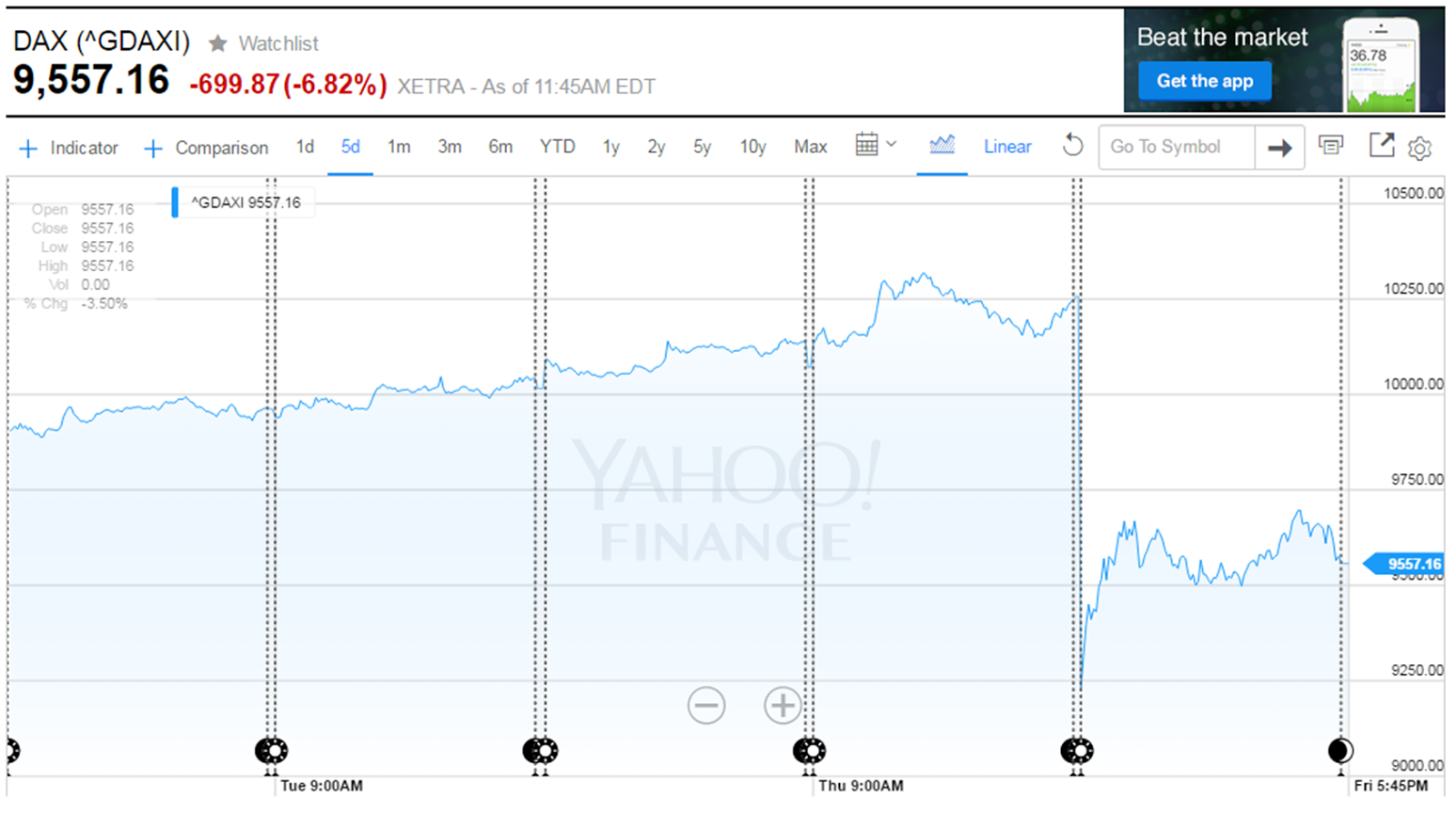
Here's the perspective I promised in the title. First, a look at the 5-day charts (all taken from Yahoo Finance) of U.S. (Dow and S&P 500), British (FTSE), Spanish (IBEX), German (DAX), and French (CAC 40) stock exchange indices:


To be sure, these are some pretty serious one-day drops. However, the Dow and S&P 500 fell more modestly than the others and the FTSE (British index) has recovered somewhat. The hardest hit so far are the European indices. Interesting, to be sure.

But what does this selloff look like over a 1 year time horizon? How far back in time do we have to go to see these indices at similar levels?


The Dow and S&P 500 are right about where they were last month. If you take out the big troughs in September 2015 and early this year, both indices are pretty much flat. The FTSE looks similar, though it seems to have a bit more of a downward trend than the U.S. The Spanish, German, and French indices are down a bit more relative to the past few months but it seems they're just continuing a downward trend that's been around for the past 12 months.

I'm not saying the referendum had no effect on the markets but after looking at these charts I'm left asking "Where's the fire?" Maybe I'm missing something, or maybe my cavalier attitude to the stock market stems from the fact that I'm 29 years old.

Thursday, May 5, 2016

Intentions, Faith, and the Nirvana Fallacy

I've addressed the Nirvana Fallacy several times on this blog, and keep finding new examples of it, especially in the popular press. Many economists seem to be unaware of this fallacy and Mark Thoma is no exception. I've critiqued him previously on this issue, but his most recent commission of the fallacy is especially interesting. Below I share key parts of his recent CBS News column (in block quotes) with some of my commentary.

The Nirvana Fallacy, as put forth by UCLA economist Harold Demsetz, is the comparison of real-world phenomena to unrealistic ideals. The mere fact that economic models can specify a perfect policy solution to a problem doesn't imply that real-world political and legal institutions can successfully implement that policy. More importantly, though, imperfections in markets which are the result of informational inefficiencies can't be solved readily by governments because the governments themselves lack the necessary information.

In addition to being quite confident about the ability of economic models to generate policies that "break up monopoly" and "force firms to pay the full cost of pollution they cause," Thoma seems to put a lot of stock in the intentions of regulators and politicians.
When government steps in to try to correct these market failures -- breaking up a monopoly, regulating financial markets, forcing firms to pay the full cost of the pollution they cause, ensuring that product information is accurate and so on -- it's not an attempt to interfere with markets or to serve political interests. It's an attempt to make these markets conform as closely as possible to the conditions required for competitive markets to flourish. 
The goal is to make these markets work better, to support the market system rather than undermine it.
It may very well be that all legislators and regulators have the purest of intentions. Even so, that doesn't imply that their policies will actually achieve the results they desire. Good intentions are a necessary but not sufficient condition for efficient and effective government solutions. Decades of work in public choice economics and more recent work in behavioral public choice show that the implementation of government policies is fraught with its own government failures. Why doesn't Thoma mention these?

Perhaps the clearest example of the Nirvana Fallacy in Thoma's column comes a few paragraphs down:
In other cases, it's less well understood that failure is the reason for the government to regulate a market, or even provide the goods and services itself. Social security and health care come to mind. But once again, the private sector's failure to deliver these goods at the lowest possible price, or to deliver them at all, is at the heart of the government's involvement in these markets. (emphases mine)
Here we have Thoma's standard for real world markets. They must deliver certain goods and services at the lowest possible price. What does he mean by "possible?" Possible in the abstract world of economic theory? Why is this a relevant comparison? Does Thoma also propose we hold the actual activities of politicians and regulators to such an ideal?

Further, I'm not sure what he means by "deliver them at all." We have accidental death and dismemberment insurance, life insurance, and health insurance in private markets and have had them for a long time. We've had health care for much longer than the government has been as heavily involved as it is now. In fact, the evidence suggests that political favoritism killed a very useful alternative health care system for the poor and blue-collar folks back in the 1930s. On the insurance side of things, it's at least plausible that increases in payroll taxes decades ago helped bring about employer-provided insurance and exacerbate the problem of preexisting conditions.

Finally, let's unpack the last two paragraphs in Thoma's column. He writes:
Conservatives tend to have more faith in the ability of markets to self-correct when problems exist, and less faith in government's ability to step in and fix market failures without creating even more problems. Honest differences on this point are likely, but there are certainly cases where most people would agree that some sort of action is needed to overcome significant market failures.
Where to start? From his use of the word "conservative" as the only descriptor of his intellectual opponents, it's clear that Thoma is thinking about this as a purely political issue, not as a technical economic issue. He also seems to think that mere faith is the only reason someone might disagree with his view. Conservatives, he says, have more faith in markets and less faith in governments. Again, the public choice literature documents quite well the problems actual politicians and regulators have with implementing the idealized policies derived from economic models. He goes on to say that honest differences are "likely," not "possibly justified" or "important to consider." It seems Thoma can't conceive of a reason for his opponents to doubt the ability of the government to fix the problems he sees with the world outside of pure ideology.

Thoma's final paragraph really demonstrates the problems with the static model through which he views the world:
However, when ideological or political goals (such as lower taxes for the wealthy or reduced regulation so that businesses can exploit market imperfections) lead to attacks on those who call for government to make markets work better -- often in the guise of getting government out of the way of the market system -- it undermines government's ability to promote the competitive market system the opponents claim to support.
Government regulations essentially amount to fixed costs that prevent new firms from entering markets and existing smaller firms from competing with larger firms. Maybe these regulations are still justified, but it's not plainly obvious using the static model Thoma seems to prefer. From their inception, anti-trust suits were and still are brought mostly by competitors, not consumers. A look at the data from the late 19th and early 20th centuries doesn't tell the same "Robber Baron" story we hear in 9th grade history texts. Output was expanding and prices falling in the industries accused of being dominated by monopolies.

Richard Langlois' recent testimony to the British Parliament on dynamic competition provides some important critiques of static models. Here are some excerpts:

On monopoly and barriers to entry:
There are only two ways that a platform can maintain prices above marginal costs. One is to be more efficient that one’s competitors – to have lower costs, for example. Such a situation would not be “policy relevant,” in the sense that taking regulatory or antitrust action against the more-efficient competitor would make society worse off. The other way to maintain price durably above marginal cost is to have a barrier to entry.  
The static and dynamic views are in agreement that competition requires free entry. Taking a static view often leads to intellectual confusions about the nature of barriers to entry (that they can arise from the shape of cost curves, for example); but in the dynamic view it is clear that barriers to entry are always property rights – legal rights to exclude others.(1) For example, one can have a monopoly on newly-mined diamonds if one owns all the known underground reserves of diamonds. More typically, especially in the case of platforms, the property rights involved are government-created rights of exclusion, either in the form of intellectual property or regulatory barriers.
On the abuse of market power:
What if it is customers who complain about the “abuse” of market power? To an economist, the problem with market power is the (static) inefficiency it creates. There is no such thing as the “abuse” of market power. Economists have understood for some time that a firm possessing market power cannot by its own actions increase that market power. The only way a firm can get market power (apart from being more efficient) is to possess a barrier to entry. What many see as “abuses” are usually what modern-day economists have come to call non-standard contracts: contractual practices beyond the simple calling out of prices in a market, practices that seem “restrictive.” These practices are often solutions to a much more complicated problem of production and sales than is contemplated in the simplified models of market power. They are very frequently an effort to overcome problems created by high transaction costs.(2)
The quality of discussions of the benefits of government intervention would be greatly improved if some notion of the costs of such intervention were mentioned. This would include discussions of dynamic models of competition and the explicit admission that politicians and regulators are subject to the same cognitive biases and information problems that cause real-world markets to deviate from the perfection of static economic models.

Saturday, April 30, 2016

Behavioral Public Choice - A Literature Review

Bryan Caplan recently posted about a fantastic West Virginia Law Review article that provides a lengthy discussion of the intersection of public choice (the application of economics to politics) and behavioral economics (the application of psychology to economics). 

Here's a segment of the introduction sans footnotes:
Behavioral public choice is both an extension of and a reaction to behavioral economics and its counterpart in legal scholarship, behavioral law and economics. Psychologists and behavioral economists have documented imperfections in human reasoning, including mental limitations and cognitive and emotional biases. Their research challenges the rational actor model of conventional economics, especially the idea that individuals acting in a free market can make optimal decisions without the government's assistance. Behavioral economists and legal scholars in the behavioral law and economics movement have used this research to justify paternalistic government interventions, including cigarette taxes and consumer protection laws, that are intended to save people from their own irrational choices. 
Because of their focus on market participants and paternalism, most behavioral economists and behavioral law and economics scholars ignore the possibility that irrationality also increases the risk of government failure. Behavioral public choice addresses that oversight by extending the findings of behavioral economics to
the political realm.  
A key insight of behavioral public choice is that people have less incentive to behave rationally in their capacity as political actors than in their capacity as market actors. 
Another law and economics article entitled "Nudging in an Evolving Marketplace: How Markets Improve Their Own Choice Architecture" tackles a similar topic. Here's the abstract:
Behavioral economics claims to have identified certain systematic biases in human decision-making with the implied assumption — sometimes leading to an explicit policy proposal — that these biases can only be corrected through centralized planning. While the appropriateness of policy corrections to perceived biases remains an open debate, far less attention has focused on the role markets already play in “nudging” consumers toward more mutually beneficial outcomes. We describe a process by which markets evolve over time to satisfy consumer preferences — or risk failure and removal from the marketplace. By organizing our understanding of markets in this dynamic, evolutionary sense, we expose a basic logic that dominates market transactions as they occur in practice; that is, the mechanisms that ultimately survive market competition tend to compensate for, limit, or otherwise reduce the incidence of bias. We explore empirical evidence for this argument in the market for consumer financial products.
This brings to mind a few previous posts of mine on market dynamics and monopoly. You can read them here, here, and here.

Friday, March 11, 2016

Relatively Good Regulation - GMO Edition

In previous posts on food labeling I've discussed food labels and the information they provide as well as possible reasons why a private GMO label hasn't already appeared. In this post, I'll discuss the reasons commodity groups are in favor of federal GMO labeling legislation.

Senator Pat Roberts (R-Kansas) recently introduced legislation that would establish federal guidelines for GMO labeling. The law would preempt state mandates for GMO food labels and start an educational campaign for the public on the safety of GMO foods.

The question isn't whether farmers, food companies, and retailers believe the guidelines are good for them financially but whether these guidelines are better than the relevant alternative. I'd wager that food companies would, in an ideal world, prefer to label their food in a manner that maximizes their profit.

Since that world doesn't exist, and there's a credible threat that interest groups in some states will successfully pass legislation mandating GMO labels, federal preemption of such laws is preferable. For producer groups, federal preemption makes it less likely that potential discounts on conventionally-produced food will be passed on to them. Additionally, the cost of educating consumers will not be borne by food companies, retailers, and farmers but by taxpayers.

As I argued in a previous post, the tremendous cost of educating the public on the safety of GMO foods is one possible reason why we haven't seen widespread efforts by food companies or third parties to create a GMO labeling scheme.  Another possible reason is the presence of substitute labels. Many consumers who are concerned about the safety of GMO food might be content buying food labeled "organic."

The more I think about it, though, the more I'm convinced that the main reason we haven't seen a third-party, private effort to create a GMO label is that the public generally trusts only the federal government to ensure food safety. It's true we have all sorts of private labels informing consumers of the characteristics of the food they buy, but safety is a separate issue in most people's minds.

The new legislation introduced is likely to be a net benefit to farmers, food companies, and retailers. They'll be shielded from the risk of more onerous regulation at the state level and won't have to bear the cost of educating the public about GMO safety. This makes the bill, from their points of view, relatively good regulation.

Wednesday, March 9, 2016

The Costs of Coordination

Sometimes the most mundane subjects can be great illustrations of basic economic concepts. Earlier this week, Alex Tabarrok (George Mason U) blogged about the benefits of coordinating leisure time. I emphasize the word "benefits" because Tabarrok completely leaves out the costs.

He starts off by citing a paper in Sociological Science whose authors find that both unemployed and employed people experience more positive emotions and and fewer negative emotions on weekends. They claim that this is evidence that time is a network good and that everyone benefits by coordinating leisure time.

Tabarrok then complains that his employer's spring break is different from his children's. He says that not only would he and his family benefit from greater coordination of spring break time, but that his employer would as well. After all, this would amount to a free benefit to employees. He ends by advocating a national holiday that would, presumably, benefit everyone. The irony here is that George Mason U is a public school and could quite easily coordinate with the local primary and secondary schools.

If the benefits are so clear, why hasn't this national holiday materialized? The simplest answer is that there are also costs of coordinating in this way. A national holiday would likely mean very high ticket prices at Disneyland and extremely long lines at the rides at Six Flags. Anyone who has ever tried to fly, go to a beach, or head to a nearby amusement park during the two weeks of spring break in mid-March has known the boredom and frustration of sitting in traffic, paying high ticket fees, and waiting in very long lines.

Contrary to Tabarrok's calls for a national holiday, it could be the case that many of us could benefit from less-coordinated holidays. There are, in many areas of the country, plenty of fine days in April and May for visiting popular attractions yet most of us have the same 2 or 3 weeks off in March. The fact that many schools are moving to a non-standard "year-round" school year in which there are several week-long breaks dotted throughout the year is an indication that the costs of coordinating leisure time may be quite high in our present system.

In any discussion of the benefits of some new social arrangement, don't forget to include the costs!

Monday, March 7, 2016

Don Boudreaux's Review of Phishing for Phools

I'm a regular reader of Don Boudreaux's (George Mason U) blog Cafe Hayek so I was glad to see his review of George Akerlof's (Georgetown U) and Robert Shiller's (Yale U) recent book "Phishing for Phools." Boudreaux's review is very good and I recommend you read the whole thing. If you're not a Barron's subscriber, you should be able to bypass the gate by searching "Boudreaux ivory tower economics" in Google News.

The review begins with a short synopsis of the book. Akerlof and Shiller argue that most people, as consumers and investors, suffer from weaknesses and informational problems that lead them to buying things they don't really want or need. Entrepreneurs who take advantage of these problems are "phishermen" and those who fall prey are "phools."

As you might expect, food is a popular topic in the book. The folks at Cinnabon are said to create a product so irresistible, yet full of empty calories, that passersby are helpless to resist. Another example are "Sunkist" oranges. According to Akerlof and Shiller, this advertising "trick" causes consumers to buy too many oranges.

It's certainly true that these products are tempting and likely deliberately so. The questions are 1) whether these temptations amount to a moral problem and 2) what is to be done. Assuming that there is a moral problem, it's difficult to know what should be done. As I've discussed previously here on the FH blog, it's not enough to criticize real-world market results relative to perfect theoretical policies drawn out on a black board. We have to compare said market results relative to policies that operate in the real world.

Here's Boudreaux's analysis of Akerlof and Shiller's solution:
Suppose it’s true, however, that modern markets are chock-full of devious phishermen preying successfully upon helpless phools who buy too many oranges in the belief that each has been “kist” by the sun. What’s to be done? The authors offer no specific proposals. Yet they clearly imply that more government regulation is a key part of the solution. At one point, for example, they advocate “more generous funding” for the Securities and Exchange Commission; at another, they speak approvingly of greater regulation of slot machines.

Solutions via government are based on a glaring fallacy: that people deficient in choosing for themselves in the marketplace will automatically shed those deficiencies once the government authorizes them to choose for others. Ironically, while citing slot machines, the authors make no mention of a related scam: government-run lotteries. The lotteries are perhaps the most obvious example of how those who are supposed to protect us from phishing scams themselves eagerly phish for phools.

Nothing, indeed, could be more phoolish than for ordinary men and women to submit to elites who are as confident as professors Akerlof and Shiller that they know best how other people should behave. Such elitism poses a far worse danger to society than entrepreneurs offering aromatic pastries for sale.

Even if people are terrible at making choices in their own best interests, a fundamental truth is that they own their lives. Self-respecting people want to be free to consult those with greater knowledge. But they would much prefer to risk undermining their own well-being through their own choices than to be saddled, bridled, and steered by self-appointed experts.

Saturday, November 21, 2015

Roman Frydman on the New Rational Expectations Hypothesis

While reading a post at the Coordination Problem blog, I came across this interview of Roman Frydman (NYU economist) by Lynn Parramore at the Institute for New Economic Thinking. The interview was very interesting and I thought I'd share some of my favorite bits. The whole thing is worth reading.

LP: It seems obvious that both fundamentals and psychology matter. Why haven’t economists developed an approach to modeling stock-price movements that incorporates both?

RF: It took a while to realize that the reason is relatively straightforward. Economists have relied on models that assume away unforeseeable change. As different as they are, rational expectations and behavioral-finance models represent the market with what mathematicians call a probability distribution – a rule that specifies in advance the chances of absolutely everything that will ever happen.

In a world in which nothing unforeseen ever happened, rational individuals could compute precisely whatever they had to know about the future to make profit-maximizing decisions. Presuming that they do not fully rely on such computations and resort to psychology would mean that they forego profit opportunities.

Sunday, November 15, 2015

Phishing for Reviews

I've read several reviews of Akerlof and Shiller's new book "Phishing for Phools." The book is largely about the ways in which businesses trick people into buying things they "shouldn't." Below I provide some key quotes from 2 positive and 1 negative reviews of the book, followed by two short, negative reviews of the summary article Shiller wrote for the New York Times. Since even the positive reviews say the book lacks depth, I think the New York Times summary is probably a reasonable proxy for the book itself, at least in terms of its primary arguments.

I've not read the book, but based on the breadth of topics covered, it may be good to have as a reference for behavioral economics articles.

Positive Reviews
The Economist:
You Have Been Warned: Two heavyweights show how markets can turn against the unsuspecting
Economic models tend to assume that people are informed about the decisions they make; in the jargon consumers have “perfect information”. This supposedly enables consumers to make markets work to their advantage. But Robert Shiller of Yale University and George Akerlof of Georgetown University argue instead that this assumption is false. There are plenty of market equilibria, the authors find, where one party is being deceived, or “phished”. You may think you are doing well out of markets; you may behave quite rationally; but in fact you are being taken for a “phool”.
The London School of Economics and Political Science - Review of Books:
Book Review: Phishing for Phools
... Nobel Prize winners George A. Akerlof and Robert J. Shiller deliver a timely and much-needed plea against the free market dogma that surprisingly seems to have outlived the financial crisis. According to the two authors, big corporations take advantage of the ‘stories we tell ourselves’ and of our ‘monkey-on-our-shoulder tastes’. Our propensity to make choices according to multiple cognitive and psychological biases makes us easy targets for the phishermen. If one sentence could epitomise their thesis, it would be Jean-Paul Sartre’s’ famous saying: ‘We are what we make of what people want to turn us into.’

Negative Reviews
Arnold Kling (author, blogger, former Fannie Mae economist):
Phools and Their Money
Overall, I do not think that the authors chose well in starting with the Cinnabon example. They do not make the case that people who buy cinnamon rolls are doing something that those consumers would rather not be doing. Instead, it just seems that such consumers are doing something that Akerlof and Shiller find reprehensible. They need to come up with an objective way of making the distinction between satisfying consumer wants and manipulating consumers. It is demagogic to rely on one person's disgust at another person's consumption of fatty foods.
Michael Makovi (recent graduate in economics, Loyola University - New Orleans):
Do Capitalists Manipulate, Deceive, and Cheat?
But government regulation is not an infallible deus ex machina. The question is not whether the market fails, but whether the government is more likely than the market itself to correct those failures. Economist Harold Demsetz coined the term “nirvana fallacy” to make this point: it is not enough to find flaws in the real world; one must prove that some feasible alternative is likely to be less flawed. James Buchanan, one of the fathers of public choice economics, compared advocates of government regulation to the judges of a singing contest who, after hearing an imperfect performance from the first contestant, immediately award the second contestant, reasoning that he must be better.

Peter Klein (Baylor University professor of entrepreneurship):
George Akerlof, Meet Oliver Williamson
Shiller's worldview features a caricature understanding of free markets along with a naive and uncomprehending model of government regulation. I suppose we can blame the Times's editorial team, not Shiller, for the headline "Faith in an Unregulated Free Market? Don’t Fall for It." But it nicely illustrates the Shiller crowd's view that support for free markets is based on faith, rather than two centuries of reason and evidence. You might think that Shiller's coauthor George Akerlof could walk down the hall and speak to his UC Berkeley colleague and fellow Nobel Laureate Oliver Williamson for a better understanding of how markets work. Williamson, of course, is famous for explaining how market actors protect themselves against opportunistic behavior from other market actors through contracts, joint ownership of assets, reputation, exchange of "hostages," and similar practices. It is markets, not government, that enable cooperation and joint production in the face of information and incentive problems.
Relevant Farmer Hayek Posts
The Nirvana Approach in Ag Economics - Contributions of E.C. Pasour

Blackboard Theory Versus the Reality of Markets

Economics in TWO Lessons?!

Demsetz on Comparative Institutions

Monday, October 26, 2015

Potpourri

Brent Gloy and David Widmar at Agricultural Economic Insights revisit the issue of declining farmland values and come to roughly the same conclusion they did earlier this year.
Farmland values and cash rents in the Corn belt continue to come under downward pressure. When current cash rents are compared to current farmland values, the outcome is a capitalization rate of around 3%. This value is reasonable given current longer term interest rates. However, the bigger question is whether cash rents can be sustained at current levels in this economic environment. 
When one considers the returns that would be generated by a farmland owner-operator relative to current farmland values the rate of return is very low. This means that farmland values and cash rents are likely too high to be justified given the current economics of crop production. This low rate of return can be addressed through farmland values and cash rental rates falling and/or the row crop income situation improving.
Jayson Lusk points to an interesting article that he says should be filed under "Unintended Consequences."
Researchers find that a ban on bottled water on the University of Vermont campus (presumably to cut down on waste) led to more plastic bottles being shipped to campus and to more soda consumption. 
Marian Tupy and Chelsea German at HumanProgress.org tackle Akerloff and Shiller's recent op-ed in the Washington post on the effects of markets on our well-being.

Arnold Kling provides some wisdom on proper critiques of economics. My favorite bit:
A bias toward “engineers” rather than “ecologists.” That distinction comes from Greg Ip’s new book, Foolproof. The engineer is like Adam Smith’s man of system, who ignores evolution, both as a factor that may permit markets to over come their own failures and as a factor that may cause government “solutions” to become obsolete.
Continuing this theme, Steve Forbes provides a critique of economic theory. I enjoyed reading the first page, but lost interest on the second.

Don Boudreaux points to Gene Epstein's response to some of Bill Gates' comments in an interview.

Thursday, October 15, 2015

Potpourri

Food
Jayson Lusk disputes the claim that local foods are good for the environment.

Helen Viet writes "An Economic History of Leftovers"

Angus Deaton's Nobel Prize
Pete Boettke's commentary

Peter Klein points to Deaton's critique of randomized control trials.

Regulation
Jared Meyer discusses the effects of regulation on economic growth.

Bonnie Christian on regulating the gig economy

David Henderson comments on Sunstein's review of Akerloff and Shiller's book "Phishing for Phools."

Tuesday, October 13, 2015

Nobel Criticism and Agricultural Economics

This year's winner of the Prize in Economic Sciences in Memory of Alfred Nobel went to Princeton economist Angus Deaton. The internet was abuzz with commentary all day, so this post is a bit late.

I would wager that most ag economists who took PhD consumer demand after 1980 used "Economics and Consumer Behavior" by Angus Deaton and John Muellbauer in that course. For those of us who don't work in development, Deaton's work on the Almost Ideal Demand System was probably our introduction to him. The blog posts I read today (here, here, here, and here) brought me up to speed on his tremendous contributions and I certainly recommend reading them.

As the title suggests, I read another commentary on the Econ Nobel that was notable for its negativity toward the prize and (at least the author seems to think) to economics in general. The article, written by anthropologist Joris Luyendijk, excoriates the Sveriges Riksbank (the Swedish central bank behind the Econ Nobel and its $1 million cash prize) for failing to present the award to social scientists in different fields, and the economics profession in general for its inability to live up to its claimed status as a science.

Certainly there's a lot packed into the article, but I just want to respond to a few things. First, no one is stopping any organization interested in sociology, anthropology, or political science from establishing an annual prize for contributions to those fields.

Tuesday, October 6, 2015

Potpourri

Bob Murphy of the Texas Tech Free Market Institute goes through the recent literature on the minimum wage.
Bob concludes:
In the 1980s, there was a genuine consensus that a 10-percent hike in the minimum wage would reduce teenage employment by 1 to 3 percent. However, in the 1990s, various "case studies" began challenging this orthodox view, and more recent studies have generalized techniques to apparently find negligible employment effects. Many economists have used this new research to assure policymakers and the public to pay no heed to warnings about harmful job losses from even aggressive minimum wage hikes.
However, in reality, the employment effect of the minimum wage is still an open question even for modest hikes. Since the 1990s, scores of articles have found negative effects of minimum wage increases. These include "case studies," with one serving as the mirror image of the famous Card and Krueger study. Furthermore, critics have challenged the entire premise of the new techniques, which claim to construct better control groups than the traditional approaches.
Finally, even if we take the very best examples of the "new" results at face value, they provide little comfort that large hikes in the minimum wage—such as a doubling to $15 per hour—will have modest impacts. Policymakers and the public should be wary of the glib assurances of some prominent economists when they claim that such large hikes will not cause teenagers to lose their jobs. The odds are very high that they will.

Arnold Kling has some more thoughts on economic methods.

Two blogs I follow both posted on Instrumental Variables regressions on the same day (here and here). I pointed this out on Twitter and they both wrote responses (here and here). Interesting stuff, but certainly wonkish.

Some interesting commentary on globalization and poor cities in the US from Kevin Williamson.

Peter Klein (and Larry Summers) on behavioral economics as a re-statement of clever (but old and well-known) business practices.
From the article Peter points to:
Have behavioral economists really discovered anything new, or have they simply replaced some wrong-headed notions of post-World War II economics with insights that people in business have understood for decades and maybe even centuries?