Showing posts with label market process. Show all posts

Monday, April 17, 2017

Sam Peltzman on Antitrust and Humility

by Levi Russell

Over at the ProMarket blog, there's a great interview of Sam Peltzman on industry concentration. The whole thing is worth reading, but I thought I'd reproduce what I think are probably the most controversial of Peltzman's responses.

Q: Which industries should we be concerned with when we look at questions of concentration?

The traditional answer, embedded in the merger guidelines, is “be concerned if concentration increases in an already concentrated industry.” The evidentiary basis for this is thin. A much older literature struggled vainly for years to find a broad pattern whereby adverse effects of concentration could be localized to highly concentrated industries. I am unaware that the state of knowledge on where we should be concerned—or indeed if we should be concerned—has improved much. Basically, antitrust policy relies more heavily on beliefs rather than a strong consensus about facts.

Q: The five largest internet and tech companies—Apple, Google, Amazon, Facebook, and Microsoft—have outstanding market share in their markets. Are current antitrust policies and theories able to deal with the potential problems that arise from the dominant positions of these companies and the vast data they collect on users?

See my answer to [the question above]. It is hubris to believe that economists and antitrust officials can predict the future, which is what you need to do in this sector. Who remembers that free web browsers were once thought to be a dangerous threat to competition?

Q: President Trump has signaled before and after the election that he may block mergers and go after certain dominant companies. What kind of antitrust policies should we expect from him? Pro-business, pro-competition, or political antitrust?

See [the questions above]. I prefer humility to hubris.

Friday, March 31, 2017

More Demsetz on Externalities

by Levi Russell

I recently ran across a lecture by Harold Demsetz presented at the Property and Environment Research Center in Montana back in 2011. Unfortunately, the video isn't online anymore, but I did find a written version. It's fairly short as lectures go, so I recommend you read it. If you don't have time to read 11 pages, check out the excerpts below.

Demsetz starts off by discussing the perfect competition model (which he calls the "perfect decentralization model"). This provides the backdrop for his discussion and critique of Pigou and Coase.
Consider Pigou’s method of argument first. He constructs examples of divergences between private and social cost. These examples differ circumstantially but in their nature s they are all the same. A favorite example involves the misallocation of traffic between two roads that connect the same terminal points. One road is subject to considerable congestion because it is narrow; the other road is wide and escapes much of this congestion but takes longer to transit because it lacks the directness of route of the narrow road. Pigou claims that the equilibrium number of autos using the narrow road will be inefficient. This is because drivers using this road do not take account of the costs of increased congestion they impose on others who use the road.  But what Pigou fails to do is show that the se example s are consistent with the presumptive conditions set down in the perfect decentralization model.  Frank H. Knight (1924), in a brilliant article on social cost, criticizes Pigou’s two -¬‐ road example. He notes that Pigou allow s free access to the two roads. Presumably, then, these roads are publicly provided and managed and, as such, cannot be a basis for criticism of private re source allocation. Knight argues that these roads, had they been private, would have been priced (in a competitive setting) so as to achieve an efficient allocation of traffic; price to use the narrow road would have been raised to levels higher than to use the broad road. Pigou’s examples do not uncover a logical flaw in the neoclassical model, since virtually all are based on an absence of private ownership. This is not to say that all resources in a real economy are privately owned but that Pigou’s work is properly interpreted in terms of the consequences of an absence of private ownership (or, more provocatively, as the presence of mismanaged public or collective ownership) than as inefficiency deduced within the context of the neoclassical model.
...
Coase noted a defect in Pigou’s argument that in its nature was much like that seen by Knight but which was not based on the absence of private ownership. Coase pointed to Pigou’s failure to recognize that the cost of using the price system disrupted the ability of a market-¬‐based price system to face users of resources with the full consequences of the uses they chose. Free use of the price system was implicitly assumed in the neoclassical model, since it treats prices as known to all who would use them. Coase’s complaint about neoclassical economics is empirical error, not logical error. The empirical error being that its model abstracts from an important aspect of the real world. As described above, Pigou gave no explanation for why a separation between private and social cost should exist in an economy that conforms to the conditions of perfect decentralization. Coase also offers no reason; instead, he openly modifies the perfect decentralization model to accommodate the fact that positive costs must be incurred to engage in exchange. The modified model allows him to rationalize the existence of a separation between private and social cost, or so he thinks. Just what this cost consists of remains somewhat vague, but I adopt Coase’s general notion.
 ...
Coase demonstrates the importance of transaction cost by way of two contrasting cases. The first shows that no difference between private and social cost can exist if the cost of transacting is zero, since, in this case, all who would bear costs from someone’s actions can bring these costs into that person’s calculations by making him or her offers to desist or modify the intended actions; similarly, this person can require revenues from those who would benefit from these actions. Nothing is left unaccounted for as long as legal rights of actions are in place. Coase’s argument is correct in this case. His presentation of the second case, involving positive transaction cost, claims that inefficiency may arise because some of the negotiations required to account for all costs and benefits cannot surmount the barrier put in place by transaction cost even if legal rights of action are in place. And here, Coase makes an error that still goes unappreciated by economists. 
 ...
Coase has treated the legal system and its courts as if they are parts of the economic system that was modeled by neoclassical economists, but, as already noted, their model assumes that all resources are privately owned and that ownership is fully respected; there is no place in it for the courtroom drama imagined by Coase. Moreover, real social systems in fact design courts so as to insulate them the influence of the marketplace. Offers and acceptances of payments to the court for desired decisions are illegal, and court survival is not made to depend on earned profit from decisions rendered. The neoclassical model of an economy and the conclusions drawn from it are confined to economic institutions, to firms, buyers, sellers and so on. The model draws no conclusions about resource allocation which results from actions taken by non-¬‐market institutions like courts and legislatures. In any case, Pigou did not base his examples of inefficiency on ownership ambiguity or court mistake.

While adopting the neoclassical perspective of market behavior, which sees ownership and markets as instruments by which resource values are maximized, Coase has relied on court decisions to assess the efficiency of the economic system. The implication he draws, that the economic system has made a mistake in allocating resources, is quite wrong. The court may have made its choice of owner for reasons different from maximization of market value or it simply may have made a mistake because it is not guided in its decisions by a market-¬‐based calculus. These reasons may seem good to some and bad to others, but they are irrelevant to the externality problem whose proper domicile is wholly within the economic system. Indeed, although there are good reasons for not creating a different legal system, if the court were to be transformed into a market institution and allowed to survive only by revenues secured from petitioners who buy its services and decisions, control of a resource would go to the person who can put it to its highest value use.

The economic system simply takes the court’s decision as an exogenously imposed constraint on its operations, much as it takes a decision by the State to tax or redistribute wealth. An efficient economic system is one that makes the most of scarce resources within the constraints handed down to it by courts and legislatures. Efficiency requires the market to block the transaction between the two claimants discussed above if the cost of their transacting exceeds the increase in value expected to be realized from a change in ownership of the resource.
 ...
There is no difference between transaction cost and other costs in this respect. The amount of soot from the production of steel may remain greater than is desired by the owner of a nearby laundry because the cost of transacting between laundry and mill owners is too great to make a transaction worth undertaking or because the launderer and steel mill owner believe that the cost of substituting hard coal for soft is greater than the cost borne by the launderer as a result of soot. In both cases, more soot descends on the laundry than if the cost of reducing soot were smaller. If we do not think resources are misallocated in the case in which hard coal is too costly to use, why should we think resources are misallocated in the case in which transaction cost is too costly to bear? Both situations are compatible with efficient resource allocation, and, after all, it is efficiency that is sought; neither negotiations nor hard coal are sought in and of themselves. Indeed, one can rewrite the neoclassical model with transaction cost included. This just shifts supply curves upward (or demand curves downward), but it carries no implications of inefficiency at equilibrium values of price and output.

I emphasize that none of what is written above denies the possibility of inefficiency in a competitive, private ownership economy. My message is that this possibility is not a result of positive transaction cost. Our reliance on a transaction cost rationale has caused us to exaggerate the scope of what externality problem might remain.
 ...

By now, the reader must suspect me of playing a word game. In part I am, but the game is not my doing. ‘Externality’ means nothing if it does not suggest something apart from a reckoning. Yet, a non-¬‐trivial component of what is written above makes a case that there is no ‘apartness’ from the market calculus. Something rationally not ‘worth’ taking into account is not equivalent to error or to inefficiency. That it is not taken into account is a reckoning if it follows from an anticipation that it is not worth taking into account. An explicit accounting for everything would be inefficient in a world in which knowledge is not free. 
 ...

Supply and demand as interpreted by the neoclassical model are expressions of true willingness to cooperate in a world that is highly dependent on specialization for its wealth. The neoclassical model faces buyers and sellers with given, non-­‐negotiable equilibrium market prices, determined on markets that cannot be influenced by individual bargaining. The model is not designed to treat strategic action, yet examples such as climate change and atmospheric quality represent problems that arise from the attempt to get others to settle for a smaller share of the surplus made available through cooperative behavior.


A close reading of Pigou and Coase does not reveal concern about strategic behavior. The distribution of traffic between Pigou’s two roads is inefficient because no price is charged for using them, not because drivers deceive each other. The failure to realize maximum value from available resources in Coase’s court room drama is a problem of legal error, not one of false testimony.


What advantage does the State bring to the resolution of strategic problems? It brings legitimate power to coerce; in these instances, the power to coerce people to pay for a public good. Just as we find that the State’s ability to coerce makes it a desirable agent in helping to maintain law and order, so we may find it a desirable agent in helping to finance production of goods and services that are important and are subject to serious strategic bargaining problems. It is possible in some instances to remedy the problem through a proper set of private rights –substitute a toll way for a free way. In other instances, the effective use of coercive power might require direct implementation by the State. People will value the alternatives of coercive State and voluntary-­‐dealings markets differently, depending on the confidence in which they hold the State and on the value they attach to personal freedom, but I see no reason to classify these important problems as externality-­‐caused inefficiencies. This now seems to me to be a classification without content.
 

Saturday, December 31, 2016

Testing Market Failure Theories

by Levi Russell

I recently picked up a copy of Tyler Cowen and Eric Crampton's 2002 edited volume Market Failure or Success: The New Debate (now only in print with the Independent Institute, though it was originally published by Edward Elgar) and have really enjoyed what I've read so far. The book is a collection of essays by prominent IO scholars organized into four sections: a fantastic introduction by the editors, four essays that form the foundation of the "new" market failure theories based on information problems, four theoretical critiques of said theories, and 8 essays providing empirical and experimental evidence of the editors' thesis: that information-based market failure theory is often merely a theoretical possibility not borne out in real life and that economic analysis of knowledge often provides us with the reasons why.

Two pieces by Stiglitz are featured in the first theoretical section: one on information asymmetries and wage and price rigidities and the other on the incompleteness of markets. Akerlof's famous "lemons" paper and Paul David's paper on path dependence are also included. I was happy to see that Demsetz's "Information and Efficiency; Another Viewpoint" was the first essay in the theoretical critique section as it sets the stage for the other chapters in that section. The empirical and experimental section features Liebowitz and Margolis' response to Paul David on path dependence in technology, Eric Bond's direct test of Akerlof's "lemons" model, and an essay I've never ready by Gordon Tullock entitled "Non-Prisoner's Dilemma."

The introduction provides a short summary of the arguments presented in the following 3 sections and includes a great discussion of the editors' views of the core problems with information-based market failures. Here's the conclusion of the intro chapter:
Our world is a highly imperfect one, and these imperfections include the workings of markets. Nonetheless, while being vigilant about what we will learn in the future, we conclude that the 'new theories' of market failure overstate their case and exaggerate the relative imperfections of the market economy. In some cases, the theoretical foundations of the market failure arguments are weak. In other cases, the evidence doe snot support what the abstract models suggest. Rarely is analysis done in a comparative institutional framework. 
The term 'market failure' is prejudicial - we cannot know whether markets fail before we actually examine them, yet most of market failure theory is just theory. Alexander Tabarrok (2002) suggests that 'market challenge theory' might be a better term. Market challenge theory alerts us to areas where market might fail and encourages us to seek out evidence. In testing these theories, we may find market failure or we may find that markets are more robust than we had previously believed. Indeed, the lasting contribution of the new market failure theorists may be in encouraging empirical research that broadens and deepens our understanding of markets.
We believe that the market failure or success debate will become more fruitful as it turns more to Hayekian themes and empirical and experimental methods. Above, we noted that extant models were long on 'information' - which can be encapsulated into unambiguous, articulable bits - and short on the broader category of 'knowledge,' as we find in Hayek [Hayek's 1945 article The Use of Knowledge in Society can be read here for free. A short explanation of the main theme of the article can be found here. - LR]. Yet most of the critical economic problems involve at least as much knowledge as information. Employers, for instance, have knowledge of how to overcome shirking problems, even when they do not have explicit information about how hard their employees are working. Many market failures are avoided to the extent we mobilize dispersed knowledge successfully. 
It is no accident that the new market failure theorists have focused on information to the exclusion of knowledge. Information is easier to model, whereas knowledge is not, and the economics profession has been oriented towards models. Explicitly modeling knowledge may remain impossible for the immediate future, which suggests a greater role for history, case studies, cognitive science, and the methods of experimental economics. 
We think in particular of the experimental revolution in economics as a way of understanding and addressing Hayek's insights on the markets and knowledge; Vernon Smith, arguably the father of modern experimental economics, frequently makes this connection explicit. Experimental economics forces the practitioner to deal with the kinds of knowledge an behavior patterns that individuals possess in the real world, rather than what the theorist writes into an abstract model. The experiment then tells us how the original 'endowments' might translate into real world outcomes. Since we are using real world agents, these endowments can include Hayekian knowledge and not just narrower categories of information. 
Experimental results also tend to suggest Hayekian conclusions. When institutions and 'rules of the game' are set up correctly, decentralized knowledge has enormous power. Prices and incentives are extremely potent. The collective result of a market process contains a wisdom that the theorist could not have replicated with pencil and paper alone.

Monday, December 19, 2016

More on Contestability and the Baysanto Merger

by Levi Russell
In a previous post, I discussed monopoly concerns with Bayer's acquisition of Monsanto. The deal was recently approved by Monsanto shareholders but will likely face significant scrutiny from anti-trust regulators.

In the previous post, I went through a paper by several Texas A&M economists that examined the likely consequences of the acquisition for several row crop seed prices. In this post, I'll make some other comments on contestability.

The A&M paper sticks to standard IO theory:
Concentrated markets do not necessarily imply the presence of market power. Key requirements for market contestability are: (a) Potential entrants must not be at a cost disadvantage to existing firms, and (b) entry and exit must be costless.
In contrast to standard IO theory, VRIO analysis suggests costs are always lower for incumbent firms. Managers of incumbent firms have experience with the specific marketing, managerial, and financial aspects of the industry that new entrants simply don't or must obtain at an additional cost.

Does this imply that no industry is "contestable" in an abstract sense? No. As I pointed out previously, prices are falling in many industries, even in those in which entry would entail 1) significant advantages for incumbents and 2) significant sunk costs. It does imply that the conditions for "contestability" are broader than the standard definition. The resource-based view of the firm provides an alternative view of contestability: The advantages for incumbents and potential sunk costs must simply be small enough that they are outweighed by an entrepreneur's expectation of economic profit associated with entering the industry.

So, when we see apparent divergences between price and marginal cost, as I see it there are three possibilities:

1) there are costs we as third-party observers don't see
2) the economic profit is associated with short-term returns to innovation (e.g. monopolistic competition)
3) there is a legal barrier to entry that is extraneous to the market itself.

This dynamic perspective (which I argue is easily teachable to undergrads) is much more powerful in advancing our understanding of real-world market behavior. Yes, the more unrealistic assumptions made in standard theory allow for more elegant mathematical modeling, but if our goal is to understand causal factors associated with firm behavior, the resource-based view of the fiirm, VRIO analysis, and other dynamic theories are more useful.

Sunday, October 23, 2016

Monopoly Concerns with Baysanto

by Levi Russell

The recent merger of DuPont/Pioneer with Dow and the acquisition of Monsanto by Bayer have sparked a lot of discussion of market concentration, monopoly, and prices. A recent working paper published by the Agriculture and Food Policy Center (AFPC) at Texas A&M University written by Henry Bryant, Aleksandre Maisashvili, Joe Outlaw, and James Richardson estimates that, due to the merger, corn, soybean, and cotton seed prices will rise by 2.3%, 1.9%, and 18.2%, respectively. They also find that "changes in market concentration that would result from the proposed mergers meet criteria such that the Department of Justice and Federal Trade Commission would consider them “likely to enhance market power” in the seed markets for corn and cotton." (pg 1) The paper is certainly an interesting read and I have no quibble the analysis as written. However, some might draw conclusions from the analysis that, in light of other important work in industrial organization, are not well-founded.

The first thing I want to point out is that mergers an acquisitions can, at least potentially, result in innovations that would justify increases in the prices of the merged firm's products. To the extent that VRIO analysis is descriptive of firm's behavior with respect to innovation, we would expect that better entrepreneurs would be able to price above marginal cost. Harold Demsetz made this point in his 1973 paper Industry Structure, Market Rivalry and Public Policy. The authors of the AFPC study point this out as well, but the problem is that, even though we have estimates of potential price increases due to the mergers, it is very difficult to determine whether any change in price in the future is actually attributable to market power or simply due to innovation in the seed technology.

Secondly, the standard models of monopoly assert that pricing above marginal cost is at least potentially a sign of a firm exercising market power. Here, articles by Ronald Coase and Armen Alchian are relevant. I provided a discussion of the relevant portions in a previous post so I'll just briefly summarize here: pricing above marginal cost is an important signal that the current market demand is potentially not being met by the firms in the industry. It's a signal to other potential investors that entering the industry might be worth it. Further, there is an issue of measurement. Outside observers may calculate fixed cost, variable cost, and price and determine that a firm is pricing above marginal cost. However, there may be costs of which said observers are unaware. For example, there may be significant uncertainty (which is not the same as risk) about the future prospects of the industry. This is certainly possible in the biotechnology industry since the government heavily regulates firms in this sector. This is not to say that such regulation is bad or should be removed, simply that it presents costs that are difficult for outsiders to calculate.

Finally, I want to examine one part of the analysis in the AFPC paper. On pages 10 and 11, the authors write (citations deleted):
A market is contestable if there is freedom of entry and exit into the market, and there are little to no sunk costs. Because of the threat of new entrants, existing companies in a contestable market must behave in a reasonably competitive manner, even if they are few in number.
Concentrated markets do not necessarily imply the presence of market power. Key requirements for market contestability are: (a) Potential entrants must not be at a cost disadvantage to existing firms, and (b) entry and exit must be costless. For entry and exit to be costless or near costless, there must be no sunk costs. If there were low sunk costs, then new firms would use a hit and run strategy. In other words, they would enter industry [sic], undercut the price and exit before the existing firms have time to retaliate. However, if there are  high sunk costs, firms would not be able to exit without losing significant [sic] portion of their investment. Therefore, if there are high sunk costs, hit-and-run strategies are less profitable, firms keep prices above average costs, and markets are not contestable. 
I submit that under this definition, scarcely any industry on the planet is contestable, yet we see prices fall in many industries over time, even in those we would expect to have significant sunk costs and in which we would expect incumbents to have significant cost advantages over new entrants.

It's true that we sometimes must make simplifying assumptions that are at odds with reality to forecast future market conditions. However, some might infer from the AFPC paper (though I stress that the authors do not) that something must be done by anti-trust authorities to unwind the mergers and acquisitions under discussion. To infer this would be to commit the Nirvana Fallacy. To expect anything in the real world (whether in markets or in the policymaking arena) to be "costless" is an impossible standard.

It will be interesting to see what becomes of these mergers and whether seed prices move sharply upward in coming years. What is certain is that there is tremendous causal density in any complex system, such as the market for bio-engineered seed. Thus, policymakers should be humble and cautious about applying the results of theoretical and statistical analysis in their attempts to better our world.

Monday, October 3, 2016

A Simple Observation

by Levi Russell

I don't claim to be the first to make this observation and it might very well be something that is discussed often in undergrad micro (though I can't find it mentioned in the 20 or so lecture notes I found online on the subject. Nevertheless, I thought I'd discuss the following briefly:
From the perspective of the consumer, price discrimination and cross subsidization are the same thing.
Here are the simple definitions Google gives when you search "price discrimination" and "cross subsidization"
price dis·crim·i·na·tion
noun
the action of selling the same product at different prices to different buyers, in order to maximize sales and profits
Cross subsidization is the practice of charging higher prices to one group of consumers to subsidize lower prices for another group.
In cases like afternoon matinees at a movie theater or senior citizen discounts at the grocery store, we can certainly see the positive side of firms charging different prices for different people. While it's true that this increases producer surplus, presumably, some of the people who receive the good at the lower price wouldn't be able to get it if the other group weren't paying a higher price.

The problem is that we use two terms to describe the same concept. The first one has a clearly negative connotation (discrimination) but the second sounds more sterile and scientific. There are certainly cases in which we might view price discrimination/cross subsidization as a bad thing. For instance, when an online retailer charges a higher price for someone who shops online a lot. Still, I can't help but think "cross subsidization" is a better term for the phenomenon since it isn't loaded with a negative connotation that might diminish students' focus on its effects, both positive and negative.

Monday, September 19, 2016

Anti-Trust vs Regulation: The Case of Baysanto

by Levi Russell

Bayer's impending purchase of Monsanto is all over the news lately. As is typical in these situations, the conversation centers around concerns of increasing market power and monopoly profits. Regular readers might expect me to focus on the notion that industry concentration doesn't necessarily imply welfare losses, but I'm not.

It seems to me that the relationship between anti-trust legislation and regulation is an under-discussed issue in these cases. Agribusiness firms are heavily regulated by three of the most powerful regulators in the US: the FDA, the USDA, and the EPA. Many regulations function as fixed costs, implying that there are economies of scale in regulatory compliance. Thus, the greater the regulatory burden placed on firms in an industry, the greater the inducement to merge.

These regulatory economies of scale militate directly against the goals of anti-trust policy. The latter, perhaps as an unintended consequence, gives us fewer and larger firms while the latter attempts to reign in these cost-saving mergers in the name of competition. If we're going to seriously discuss regulation and anti-trust, we need to be cognizant of the interplay between them.

Of course, there are plenty of problems with the regulatory revolving door and other public choice issues to deal with as well. On this front, it seems fairly obvious that the incentive to rent-seek is positively correlated with the prize being offered. Perhaps this is an argument for less power vested in the administrative state and more power returned to the courts.

Thursday, September 15, 2016

Coase and Hog Cycles

by David Williamson

If you read this blog, then you're probably familiar with Ronald Coase's work on the importance of transaction costs. But did you know that Coase devoted a substantial portion of his early career to criticizing the Cobweb Model? He actually wrote 4 separate articles on the subject between 1935 and 1940, but not one makes Dylan Matthew's list of Coase's top-five papers. This work is actually really fascinating in the context of economic intellectual history, so here is a quick summary!  

The 1932 UK Reorganization Commission for Pigs and Pig Products Report

It all started when the UK Reorganization Commission for Pigs and Pig Products claimed in a 1932 report that government intervention was needed to stabilize prices in the hog industry. The Commission found that hog prices followed a 4-year cycle: two years rising and two years falling. The Commission explained this cyclical behavior using the Cobweb Model. In this model, products take time to produce. So, to know how much to produce, firms have to guess what the price will be when their product is ready to bring to the market. If producers are systematically mistaken about what prices will be, this could lead to predictable cycles in product spot prices.

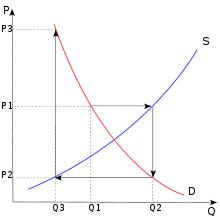
The Cobweb Model

How forecasting errors can lead to cycles in product prices is illustrated in the figure below. Suppose we begin time at period 1 and hog producers bring Q1 to the market to sell. Supply is essentially fixed this period because producers can't produce more hogs on the spot, so the price that prevails on the market will be P1. Since this price exceeds the marginal cost of production (represented by S), the individual producers wish they had produced more. Now, when the producers go back home to produce more hogs, they have to guess that the price will be when their hogs are ready to sell. Suppose it will take 2 years to produce more hogs. The UK Reorganization Commission argued that hog producers will assume the price of hogs next period will be the same as it was this period (in other words that producers had "static" expectations about price). That means, in this context, hog producers think the price of hogs in 2 years will still be P1. So each producer will individually increase production accordingly. However, when the producers return to the market in 2 years, they will find that everyone else increased production too and that quantity supplied is now Q2. As a result, the price plummets to P2 and the producers actually lose money. Not learning their lesson, the hog producers will again go home and assume that the price next period will be P2 and collectively cut back their production to Q3. Hopefully you see where this is going, even if the hog producers don't. The price will go up again in 2 years and then down again in 2 more. Thus, we have a 4-year cycle in hog prices. How long will this cycle continue? That depends on the elasticities of supply and demand. If demand is less elastic than supply, as was believed to be the case in the hog market, then the price swings will continue forever and only get bigger as time goes on.

220px-Cobweb_theory_(divergent).svg.png
Source: Wikipedia

Coase Takes the Model to the Data

The Cobweb Model is really clever, but does it actually capture the reality of the hog market? Coase and his co-author Ronald Fowler tried to answer that question by evaluating the model's assumptions. First, are hog producer expectations truly static? Expectations cannot be observed directly, but Coase and Fowler (1935) used market prices to try and infer whether producer expectations were static. It didn't seem like they were. Second, does it really take 2 years for hog producers to respond to higher prices? Coase and Fowler (1935) spend a lot time discussing how hogs are actually produced. They found that the average age of a hog at slaughter is eight months and that the period of gestation is four months. So a producer could respond to unexpectedly higher hog prices in 12 months (possibly even sooner since there were short-run changes producers could also make to increase production). So why does it take 24 months for prices to complete their descent? Even if we assumed producers have static expectations, shouldn't we expect the hog cycle to be 2 years instead of 4?  

This evidence is hard to square with the Cobweb Model employed by Reorganization Commission, but Coase's critics were not convinced. After all, if it wasn't forecasting errors that were driving the Hog Cycle, then what was? "They have, in effect, tried to overthrow the existing explanation without putting anything in its place" wrote Cohen and Barker (1935). Coase and Fowler (1937) attempted to provide an explanation, but this question would continue to be debated for decades.

The Next Chapter

Ultimately, John Muth (1961) proposed a model that assumed producers did not have systematically biased expectations about future prices (in other words that they had "rational" expectations). Muth argued this model yielded implications that were more consistent with the empirical results found by Coase and others. For example, rational expectations models generated cycles that lasted longer than models that assumed static or adaptive expectations. So a 4-year hog cycle no longer seemed as much of  a mystery. I'm not sure what happened to rational expectations after that. I hear they use it in Macro a bit.  Anyways, if you are interested in a more detailed summary of Coase's work on the Hog Cycle, then check out Evans and Guesnerie (2016). I found this article on Google while I was preparing this post and it looks very good.

References

Evans, George W., and Roger Guesnerie. "Revisiting Coase on anticipations and the cobweb model." The Elgar Companion to Ronald H. Coase (2016): 51.

Coase, Ronald H., and Ronald F. Fowler. "Bacon production and the pig-cycle in Great Britain." Economica 2, no. 6 (1935): 142-167.

Coase, Ronald H., and Ronald F. Fowler. "The pig-cycle in Great Britain: an explanation." Economica 4, no. 13 (1937): 55-82.

Cohen, Ruth, and J. D. Barker. "The pig cycle: a reply." Economica 2, no. 8 (1935): 408-422

Muth, John F. "Rational expectations and the theory of price movements."Econometrica: Journal of the Econometric Society (1961): 315-335.

Wednesday, September 7, 2016

Remembering Ronald Coase

by Levi Russell

The third year anniversary of Ronald Coase's death was last Friday. My Facebook and Twitter were alive with remembrances of this great economist, so I thought I'd put a few articles/videos/podcasts related to Coase for FH readers.

Though Coase is most famous for his work on transaction costs, what I find most interesting about his is his unique approach to economics in general. In the opening of this video interview, Coase says "Economics has become a theory-driven subject and I believe the approach should be empirical. You study the system as it is, understand why it works the way it does, and consider what changes could be made and what effects they would have." Coase derisively referred to abstract theoretical economics as "blackboard economics." In reading his work, the reader gets the sense that Coase is looking at the behavior of real people and trying to determine the underlying causal mechanisms. This is what makes Coase a great economist.

Here's an article on Coase that gives his background and surveys his most popular work. Here's a video featuring lectures on Coase's contributions by other well-known economists.

The video I linked to above, as well as this blog post of mine featuring Deirdre McCloskey, corrects the record on "the Coase Theorem." Speaking of my blog posts, here's another one that provides a summary of one of Coase's lesser-known, but no less fantastic, papers.

Finally, this post of mine summarizes a point by Bryan Caplan that, given his stated perspective on economic theory, I think Coase would have appreciated. It's a simple empirical observation that fundamentally challenges typical applications of standard monopoly theory.

Thursday, July 14, 2016

Regulating the Regulatory Process

by Levi Russell

I suppose this is Mercatus Center week, but I can't resist sharing some great analysis and commentary from their researchers.

Senior Research Fellow Patrick McLaughlin recently testified before Congress on the need for an established process of regulatory form at the federal level. Drawing on the experience of the UK and Canada, McLaughlin presents several methods of establishing "regulatory budgeting." He describes this method of regulatory error correction this way:
Regulatory budgets, like other types of budgets, only work if they force the spender to identify and prioritize the most valuable options. The behavior of an agency with a budget differs from that of an agency without a budget. In today’s no-budget world, an agency’s objective is to fulfill its mission with the promulgation of rules. The effectiveness and efficiency of those rules are not evaluated in hindsight, and prospective evaluation of effectiveness and efficiency only occurs for less than one percent of all new rules. In contrast, an agency with a regulatory budget would act differently. First, the agency would avoid new regulations that would not achieve high benefits relative to their budgetary cost. Second, the agency would have incentive to eliminate old regulations that are found to be ineffective or intolerably inefficient. In other words, a regulatory budget process would resemble an error-correction process: it would lead to fewer new errors as well as aid in the identification and correction of existing ones.
 McLaughlin goes on to explain methods of setting the regulatory budget limit and several measures of regulation that could be used in this approach. I highly recommend reading the whole testimony.

Here's the conclusion:
Regulators and legislators alike are not perfect. Regulations are perhaps unique in the sense that they are undeniably important to all actions in the economy, but are not subject to a process for error correction. These errors—most of which are probably undiagnosed owing to the lack of retrospective analysis—are far from benign. They contribute to regulatory accumulation, a force that disproportionately harms low-income households, deters innovation, and slows economic growth, without delivering offsetting benefits. The reduction of the error rate requires a process that ensures the development and application of high-quality information, both before and after the effects of regulations have been observed. Regulatory budgeting represents one option to achieve just that.

Regulatory budgeting would lead to the creation of better information about the effects of regulations. Simultaneously, it would create incentives for regulators to act upon that information, promulgating those regulations that offer the greatest benefit relative to costs and eliminating regulations that impose an undue burden on the American people.

Sunday, June 19, 2016

Specialization and Trade - A Reintroduction to Economics

That's the tile of Arnold Kling's newest book. It's published by the Cato Institute and is available in e-book format on Amazon for a mere $3.19. You can also download a PDF copy here free. Arnold Kling is an MIT trained economist who spent the bulk of his professional economic career at the Federal Reserve and Freddie Mac. Kling's blog, one of the best on the web in my opinion, is always thought-provoking. As the title of his blog suggests, he makes every effort to understand and fairly state the positions of those with whom he disagrees.

I read a couple of blurbs about the book last week and have only just finished the first chapter. So, rather than write a review, I'll reproduce a section of the Introduction that gives a short description of each chapter. Kling certainly has a unique perspective and I suspect I'll learn a lot from this relatively short book.
“Filling in Frameworks” wrestles with the misconception that economics is a science. This section looks at the difficulties that economists face in trying to adopt scientific methods. I suggest that economics differs from the natural sciences in that we have to rely much less on verifiable hypotheses and much more on hard-to-verify interpretative frameworks. Economic analysis is a challenge, because judging interpretive frameworks is actually harder than verifying scientific hypotheses. 
“Machine as Metaphor” attacks the misconception held by many economists and embodied in many textbooks that the economy can be analyzed like a machine. This section looks at a widely used but misguided approach to economic analysis, treating it as if it were engineering. The economic engineers are stuck in a mindset that grew out of the Second World War, a conflict that was dominated by airplanes, tanks, and other machines. Their approach fails to take account of the many nonmechanistic aspects of the economy. 
“Instructions and Incentives” deals with the misconception that economic activity is directed by planners. This section explains that although people within a firm are guided to tasks through instruction from managers, the economy as a whole is not coordinated that way. Instead, the price system functions as the coordination mechanism. 
“Choices and Commands” is concerned with the misconceptions held by socialists and others who disparage the market system. This section explains why a decentralized price system can work better than a centralized command system. Central planning faces an information problem, an incentive problem, and an innovation problem. 
“Specialization and Sustainability” exposes the misconception that we must undertake extraordinary efforts in order to conserve specific resources. This section explains how the price system guides the economy toward sustainable use of resources. In contrast, individuals who attempt to override the price system through their individual choices or by imposing government regulations can easily miscalculate the costs of their actions. 
“Trade and Trust” addresses the misconception among some libertarians that the institutional infrastructure needed to support specialization and trade is minimal. Instead, this section suggests that for specialization to thrive, societies must reward and punish people according to whether they play by rules that facilitate specialization and trade. A variety of cultural norms, civic organizations, and government institutions serve this purpose, but each of those institutions has its drawbacks. 
“Finance and Fluctuations” deals with the misconceptions about finance that are common among economists, who often fail to appreciate the process of financial intermediation. This section looks at the special role played by financial intermediaries in enabling specialization. Intermediation is particularly dependent on trust, and as that trust ebbs and flows, the financial sector can amplify fluctuations in the economy’s ability to create patterns of sustainable specialization and trade. 
“Policy in Practice” corrects the misconception that diagnosis and treatment of “market failure” is straightforward. This section looks at challenges facing economists and policymakers trying to use the theory of market failure. The example I use is housing finance policy during the run-up to the financial crisis of 2008. The policy process was overwhelmed by the complexity of the specialization that emerged in housing finance. Moreover, the basic thrust of policy was determined by interest-group influence. The lesson is that a very large gap exists between the economic theory of public goods and the practical execution of policy. 
“Macroeconomics and Misgivings” argues that it is a misconception, albeit one that is well entrenched in the minds of both professional economists and the general public, to think of the economy as an engine with spending as its gas pedal. This section presents an alternative to the mainstream Keynesian and monetarist traditions. I argue that fluctuations in employment arise from changes in the patterns of specialization and trade. Discovering new patterns of sustainable specialization and trade is more complex and subtle and less mechanical than what is assumed by the Keynesian and monetarist traditions.